Bookcase Depth and Shelf Spacing Guide (Plus Library Tables)
 By Michael King, Owner

The average bookshelf depth is about 12 to 16 inches. Of the 163 freestanding bookcases on our site that list a size, 138 fall in that range, and the middle (median) depth is 14 inches. Twelve inches holds most hardcovers and paperbacks standing up. Go deeper, 16 to 20 inches, for oversized art books, binders, baskets or a bookcase beside a TV.
Key takeaways
- Most bookcases we sell are 12 to 16 inches deep. The shallowest is 12 inches and the deepest freestanding one is just over 20 inches.
- A standard octavo book is about 6 by 9 inches, so even a 12-inch shelf leaves room. Big quartos and folios are what push you deeper.
- In our bookcase lines, each extra foot of height usually adds one more shelf: two adjustable shelves at 36 inches tall, six at 84 inches.
- Some wide bookcases add a center divider to keep shelf spans short, and tall bookcases should be anchored to the wall.
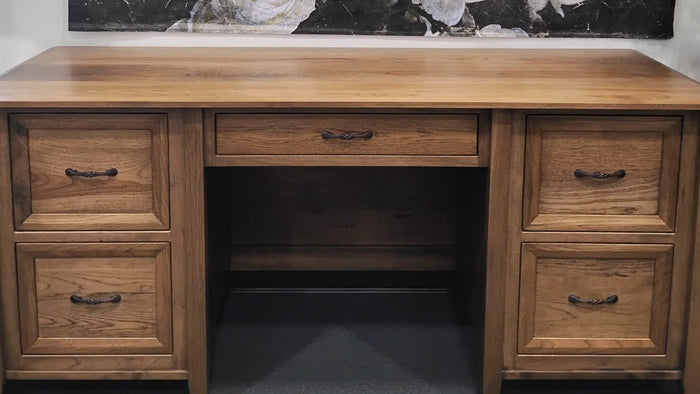
- A library table is a large writing table. The five on our site are 62 to 72 inches wide and 30½ inches tall.
What is the average bookshelf depth?
There is no one official standard, so the most useful answer is what bookcases are actually built to. We pulled the first size listed on each of the 163 freestanding bookcases on our product pages (lateral file combinations and storage beds left out). Here is how their depths spread out:
| Depth | Bookcases on our site | What fits well |
|---|---|---|
| 12 to just under 14 inches | 65 | Novels, paperbacks, most hardcovers, cookbooks |
| 14 to just under 16 inches | 65 | Hardcovers with room in front for a photo or a small plant |
| 16 to just under 18 inches | 24 | Larger art and coffee table books, baskets, media |
| 18 inches or more | 9 | Oversized books, binders, display pieces |
The median is 14 inches and the mean is a little over 14. A few real examples from our pages show the range:
- The Vienna Bookcase is 12¼ inches deep in every height, from 36 to 84 inches tall.
- The Hand Hewn Bookcase with Doors is 14 inches deep, with a 1¼-inch top.
- This Spindle Bookcase is 18 inches deep, and its page also lists a narrow 24-inch-wide version that is 12 inches deep.
- The Barrister Bookcase is 19 inches deep, and the Master Bookcase is 20 inches deep.
Office pieces that combine a lateral file base with a bookshelf top are deeper again. On our site they run 22 to 25 inches deep, because the file drawers below need the room.
How deep should a bookcase be for your books?
When a book stands upright on a shelf, its width becomes its depth. So the real question is how wide your widest books are. Libraries and publishers use old names for book sizes, and Wikipedia's summary of them gives a good guide:
| Book size | Typical page size (width x height) | Shelf depth it needs |
|---|---|---|
| Crown octavo | about 5⅜ x 8 inches | Any bookcase on our site |
| Octavo | about 6 x 9 inches | Any bookcase on our site |
| Quarto | about 9½ x 12 inches | 12 inches or more, with taller shelf gaps |
| Folio | about 12 x 19 inches | 16 inches or more, or lay it flat |
Wikipedia notes that octavo and quarto are the most common book sizes today. That is why a 12-inch shelf works for most home libraries: a 6-inch-wide novel leaves half the shelf free. If you mostly read paperbacks, a deeper bookcase isn't better. Books slide to the back, and the front of the shelf collects clutter.
Matching the shelf to the book is an old idea. Thomas Jefferson's book boxes, which Wikipedia describes as pine boxes with shelves but no fronts, had a different depth on each shelf, from 13 inches down to 5¾ inches.
When to go deeper
- You collect art, photography or travel books in large formats.
- You want baskets, binders or boxes on the lower shelves.
- The bookcase sits next to a TV console and should line up with it. One entertainment center on our site pairs a 19½-inch-deep console with 16¼-inch-deep bookcases on each side.

How far apart should bookshelves be?
Shelf spacing depends on the height of your books, not on a fixed number. Most bookcases make this easy with adjustable shelves: 127 of the 163 freestanding bookcases on our site list them.
The size charts on our product pages also show a simple pattern. In the Ashery Oak lines, a 24- or 36-inch-wide bookcase gets one more adjustable shelf for each extra foot of height:
| Bookcase height | Adjustable shelves (24" and 36" wide) | Adjustable shelves (48" wide, two columns) |
|---|---|---|
| 36 inches | 2 | 4 |
| 48 inches | 3 | 6 |
| 60 inches | 4 | 8 |
| 72 inches | 5 | 10 |
| 84 inches | 6 | 12 |
Examples: the Vienna line (24 and 48 inches wide) and the Hand Hewn line (36 inches wide). Other makers count differently. The Rivertowne line lists one shelf at 36 inches up to five at 84 inches, plus a fixed top shelf.
That works out to about one opening per foot of height, which clears a 9-inch octavo with room for your fingers. Quartos are about 12 inches tall, so give them one taller opening, usually at the bottom where heavy books belong anyway.
Tips for setting the shelves
- Sort first, then set the shelves. Group books by height and set each opening for its tallest book.
- Keep books upright and supported. The Northeast Document Conservation Center (NEDCC) advises shelving books upright with smooth, broad bookends so they don't lean.
- Don't pack them tight. NEDCC also warns that books shelved too tightly get damaged when you pull them out, and that a growing collection needs room to expand.
- Heavy books low. It keeps the weight near the floor.
What are the most common bookcase heights and widths?
On our site, 72 inches is the most common height (41 of the 163 bookcases), followed by 36 inches (26) and 84 inches (16). For width, 36 inches leads (50 bookcases), then 48 inches (36) and 24 inches (21).
Check your ceiling before you pick the tallest size. A standard 8-foot ceiling is 96 inches, so an 84-inch bookcase leaves about 12 inches above it. Check for vents and smoke detectors first.
How wide can a bookshelf be before it sags?
Every wood shelf bends a little under load, and it keeps bending slowly if the load stays. Engineers call this creep. The American Wood Council explains that under long-term loading, the expected deflection for seasoned lumber is about 1.5 times the initial deflection. A shelf full of books is exactly that kind of long-term load.
The simplest fix is a shorter span. That's why some wide bookcases on our site split the width: the 48-inch Vienna bookcases are built as two side-by-side columns (see the photo above), and the Rivertowne line adds a center divider to its 60- and 72-inch-wide cases. If you want one long run of books, two or three narrower bookcases side by side do the same job as one very wide one.
If you are comparing materials, our guide to solid wood vs veneer vs MDF shows how to check what a shelf is made of.

Open bookcase, doors or barrister?
- Open shelves are easiest to reach and show off the spines. They also collect the most dust.
- Doors hide the bottom shelves for games, files or extra books. Of the 163 freestanding bookcases on our site, 57 mention doors, and 10 call out glass doors.
- Barrister bookcases put a glass door on each shelf. Wikipedia explains the style started as portable bookcases for traveling lawyers, with an "up and over" door on each shelf. On our Barrister Bookcase, the doors slide up and in to open, and more bookcases can be added to the sides.
Do bookcases need to be anchored to the wall?
Yes, especially tall ones. The U.S. Consumer Product Safety Commission's Anchor It! campaign says anchoring all furniture with drawers, doors and shelves to the wall prevents tip-over injuries and deaths. Existing furniture can be secured with anti-tip brackets. Load the heaviest books on the bottom shelves, and keep tempting items off the top where children might climb for them.
What is a library table?
Collins Dictionary defines a library table as "a large pedestal writing table or desk." At home, it's a working surface for spreading out books, writing, studying or working on a laptop. It should stay flat and steady while you lean on it, because a table that moves breaks your focus.
The five library tables on our site, all from DutchCreek Design, share a few details:
- Size: 62 to 72 inches wide and 28 to 32 inches deep, all 30½ inches tall. The Villa Library Table is the smallest at 62 by 28 inches.
- Drawers: all five list dovetailed drawers on full extension slides. Four have a pencil drawer.
- Keyboard: the Montereau has a keyboard pullout in the center, and on the Kingston, Paris and Villa a pullout keyboard can replace the pencil drawer.
A library table pairs well with a wall of bookcases. If you need more drawer storage, look at the full range of desks as well.

How to plan a home library wall
- Measure the wall and ceiling. Note the width, the ceiling height and where outlets, vents and windows sit.
- Measure your biggest books. The widest book sets the depth, and the tallest sets your largest shelf opening.
- Pick a depth. 12 to 14 inches for most collections, 16 inches or more for large formats or a TV wall.
- Split long walls. Several 36- or 48-inch bookcases side by side keep shelf spans short.
- Leave space for a table and a chair. A library table in front of the shelves turns the wall into a place to read and work.
- Anchor every tall case.
Because most of our furniture is made to order, you can usually choose the wood, stain and hardware, and ask about sizes. Browse all our bookcases, see the office collections, or visit our showrooms in Intercourse and Lancaster, PA and Murrells Inlet, SC to see the depths in person.
Bookcases and library tables from our collection
 Vienna Bookcase
 Hand Hewn Bookcase with Doors
 Barrister Bookcase
 Kingston Library Table
Frequently asked questions
What is the standard depth of a bookshelf?
There's no official standard, but most bookcases are 12 to 16 inches deep. On our site, 138 of 163 freestanding bookcases fall in that range, and the median is 14 inches.
Is 12 inches deep enough for a bookshelf?
For most books, yes. A common octavo book is about 6 inches wide, and a quarto about 9½ inches, so both fit on a 12-inch shelf. Large folios and art books are the exception.
How much space should be between shelves?
Set each opening for the tallest book on that shelf. In our bookcase lines, a shelf is added for about every foot of height, which clears standard 9-inch books. Give quartos and big books one taller opening near the bottom.
What is a library table?
A large writing table for reading, writing and study. The library tables on our site are 62 to 72 inches wide, 28 to 32 inches deep and 30½ inches tall, with dovetailed drawers and, on four of the five, a pencil drawer.
Do I need to anchor a bookcase?
Yes. The CPSC's Anchor It! campaign recommends anchoring all furniture with drawers, doors and shelves to the wall to prevent tip-overs, which matters most in homes with children.
How deep is a barrister bookcase?
The one on our site is 19 inches deep, 40¼ inches wide and 85¾ inches tall, deeper than most open bookcases.
Sources
- Wikipedia: Book size
- Wikipedia: Bookcase (barrister's bookcase, Jefferson's book boxes)
- NEDCC Preservation Leaflet 4.1: Storage and Handling for Books and Artifacts on Paper
- American Wood Council: What is creep and how can I address it?
- U.S. CPSC Anchor It!: How to anchor
- Collins Dictionary: library table
- Product pages on kingsamishfurniture.com (sizes, shelf counts and features as listed in November 2026)
How we made this guide: we compared the sizes, shelf counts and features listed on the 163 freestanding bookcases and five library tables on our site, read the sources above, and reviewed questions customers ask our team. Every fact was checked against our product pages.
See it in person
Visit our showrooms in Intercourse and Lancaster, PA, and Murrells Inlet, SC. Open Monday to Friday 10 to 5, Saturday 9 to 5.