Dining Room Furniture for Entertaining: Tables, Benches and Buffets for a Crowd
 By Michael King, Owner

Good dining room furniture for entertaining does three jobs: it stretches to seat more people, it keeps everyone comfortable for a long meal, and it gives you somewhere to serve. In practice that means an extension table with leaves, a mix of chairs and a bench for extra seats, and a sideboard or buffet for platters, plates and drinks.
Key takeaways
- Leaves are the easiest way to seat a crowd. 168 of the 178 dining tables on our site can be ordered with leaves or a butterfly leaf, and 81 take up to four.
- Plan about 24 inches of table edge per guest. Four 12-inch leaves add 48 inches, which is room for about four more people.
- A bench seats more people in less space than chairs, and arm chairs take extra width: on our chair pages the arm chair is a median 4½ inches wider than the side chair.
- A sideboard or buffet near the table becomes your serving station, so the table stays clear for eating.
What dining room furniture do you need for entertaining?
Hosting isn't about owning more furniture. It's about pieces that can change size and stay out of the way. This table sums up what each piece does when you have company, with numbers from the furniture on our site.
| Piece | Its job when you host | What to look for | From our catalog |
|---|---|---|---|
| Extension table | Seats your household most days and more guests when the leaves go in | Number of leaves, leaf storage, room to walk around it when fully open | 81 tables take up to four 12" leaves; 58 list leaves that store inside the table |
| Bench | Fits extra people, especially kids, on one side | Length close to the table's, back or backless, matching finish | 51 dining benches, from 36" up to 96" long |
| Side and arm chairs | Comfort for long meals and older guests | Seat width, arms only where there's room | Side chairs run 17" to 21" wide; arm chairs 17½" to 26¼" |
| Sideboard, buffet or server | Serving surface plus storage for dishes and linens | Top length, height, drawers for flatware | 65 serving cabinets; 28 mention wine storage |
If you are still choosing the size and shape of the table itself, start with our guide on how to choose the right dining table. This guide picks up from there and focuses on hosting.
Is an extendable dining table worth it for hosting?
For most families who host, yes. Merriam-Webster defines an extension table as "a table that can be extended in length by the insertion of a leaf." That one feature lets you keep a table sized for everyday meals and open it up only when the house fills.
It's also the most common option on our tables. Of the 178 dining tables on our site, 168 can be ordered with leaves or a butterfly leaf. 81 can take up to four leaves, 60 up to two, and 86 offer an 18-inch butterfly leaf that folds out from the center. Most of the standard leaves on our pages are 12 inches wide. A few tables, such as the Edison Double Pedestal Table, also offer two 18-inch end leaves.
What to check before you buy
- Where the leaves live. 58 of our table pages list leaves that store inside the table. Otherwise, plan a closet or under-bed spot where they can lie flat.
- The fully open length. A 72-inch table with four 12-inch leaves opens to 120 inches. Measure your room for that number, not just the closed size.
- How it opens. 92 of our table pages describe the slides that pull the table apart, most of them wooden, and 66 mention an equalizing gear so both halves open evenly.
How many people fit at a dining table with the leaves in?
A simple rule from the National Kitchen & Bath Association (NKBA) planning guidelines: allow a space about 24 inches wide for each seated diner. So every 12-inch leaf adds about half a seat on each side, and two leaves add roughly one seat per side.
The table pages on our site that list seating agree. A 42 x 72 table is listed at 6 seats with a solid top and 10 seats with four leaves. On a 42 x 60 table, two leaves take it from 6 to 8 seats. Those are comfortable numbers, with room for elbows and serving dishes.
Leave room to walk behind the chairs
A longer table eats into your walkway. The NKBA suggests at least 36 inches from the table edge to a wall or cabinet so someone can edge past a seated guest, and 44 inches so they can walk past. If the leaves would leave less than that, it may be better to set up a second small table in the next room than to push the main one wall to wall.

Bench or chairs: which is better for a crowd?
Merriam-Webster calls a bench "a long seat for two or more persons," and that is exactly why hosts like them. With no gaps between chairs, people can slide closer together when one more guest arrives. Benches work well for kids, and a bench tucks under the table when you need the floor space.
We carry 51 dining benches on our site, from 36 inches to 96 inches long, and 18 of them come in 84 inches or longer. All 39 of the backless ones are 13½ to 14½ inches deep. Some of our dining lines, like Edison, offer a table, a bench and chairs under the same name, so the set matches.
When chairs win
Benches aren't for everyone. Older guests, or anyone sitting through a long meal, may want a back and something to push up from. Only 12 of our dining benches have a back. Chairs also let each guest pull in or out on their own.
If you choose chairs, watch the arms. On the 176 chair pages that list both sizes, the side chairs run 17 to 21 inches wide and the arm chairs run 17½ to 26¼ inches. The Edison Chair, for example, is 19½ inches wide as a side chair and 26 inches as an arm chair. A common plan is arm chairs at the two ends and side chairs along the sides, which saves width where you need it most.
A mix often works best
Many hosts put a bench on the wall side, where it's hardest to get in and out of a chair, and chairs on the open side. You get the extra seats of a bench and the comfort of chairs in one table.
Where do extra guests sit?
A table with four leaves can seat more people than you own chairs. Plan the extra seats before the big day:
- Buy two or four extra side chairs in the same style and keep them in a bedroom, office or entry until you need them.
- Use a bench as the stretch seat on one side. People can sit closer together on a bench than on separate chairs.
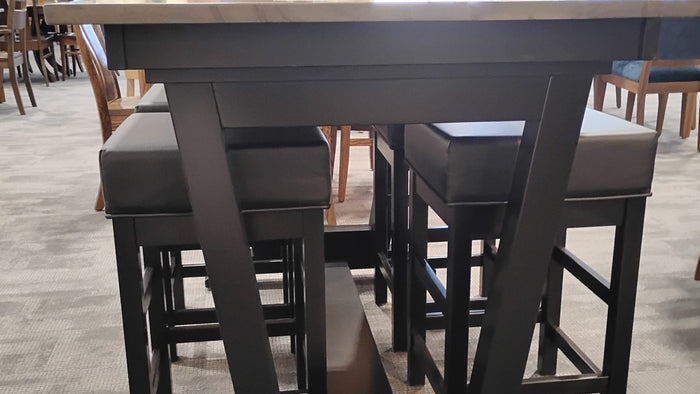
- Borrow from the kitchen. If you have counter stools, guests can gather at the island for appetizers before dinner.
- Save one open spot for a guest who uses a wheelchair. The ADA standards for public dining surfaces call for a top 28 to 34 inches high, open knee space underneath (measured from 9 to 27 inches above the floor), and a clear floor space of at least 30 by 48 inches. Pick the spot where no leg or pedestal sits under the edge.
Do you need a sideboard or buffet for entertaining?
If you host often, a sideboard may be the piece you use the most after the table. Merriam-Webster's meal sense of "buffet" says it all: a "meal set out on a sideboard, table, or countertop for guests to serve themselves." Moving the platters off the table frees room for plates, glasses and elbows.
We list 65 serving cabinets on our site, including buffets, sideboards, servers and bars. 51 of them list dovetailed drawers, which is handy for flatware and napkins, and 28 mention wine storage. Most buffets and sideboards stand 34 to 46 inches tall, a comfortable height to serve from. One piece is built for hosting: the Shreve Port Server Table has wings on the top that flip out to expand the serving area.
Not sure whether you need a buffet, a sideboard or a hutch? Our guide on hutch vs sideboard vs credenza explains the differences. You can browse all of them in our serving cabinets.
Serve food safely from the sideboard
The FDA's advice for home buffets fits a sideboard well. Keep serving portions small, keep backup dishes in the refrigerator or a warm oven, and swap in fresh platters during the party. Follow the 2-hour rule: throw out perishable food that has sat at room temperature for more than 2 hours, or 1 hour if the room is above 90°F.

How do you set up the dining room before guests arrive?
- Put the leaves in early. Do it the day before, so you can check the walkway and count chairs without a rush.
- Count seats, not chairs. Add up chairs, bench spots and any stools, and set aside the open spot for a wheelchair if a guest needs it.
- Set the serving station. Put plates at one end of the sideboard, then food, then flatware and napkins at the far end, so the line moves one way.
- Protect the top. Use trivets under hot dishes and coasters under glasses. Our furniture care guide covers cleaning up after the meal.
Most of our furniture is made to order, so you can often choose the table length, the number of leaves and the bench size to fit your room. Our guide on ordering custom Amish furniture walks through the steps. If you'd like to sit at a table with the leaves in, visit one of our showrooms in Intercourse or Lancaster, PA, or Murrells Inlet, SC. They're open Monday to Friday 10 to 5 and Saturday 9 to 5, and closed Sunday. Before you go, read what to expect when you visit.
Pieces for hosting a crowd
 Edison Double Pedestal Table
 Edison Bench
 Edison Chair
 Shreve Port Server Table
Browse more dining tables, benches and chairs.
Frequently asked questions
How many people can sit at a 6-foot dining table?
A 6-foot (72-inch) table seats about 6 people. On our table pages, a 42 x 72 table is listed at 6 seats with a solid top and 10 with four leaves. With 12-inch leaves, that opens it to 120 inches.
What kind of dining table works for entertaining?
An extension table that fits your room when it's closed and still leaves a walkway when it's open. Look at how many leaves it takes, where the leaves are stored, and how long it gets with all of them in.
Is a bench comfortable for dinner parties?
For kids and most adults, yes, and it seats more people in less space. For older guests or long meals, a chair with a back is easier. Many hosts use a bench on one side and chairs on the other.
How much space do you need between the table and a sideboard?
The NKBA guidelines suggest at least 36 inches from the table edge to a wall or cabinet to edge past a seated person, and 44 inches to walk past. Measure with the leaves in.
Sources
- NKBA Kitchen Planning Guidelines (seating space and traffic clearance)
- U.S. Access Board: ADA Accessibility Standards, sections 305, 306 and 902
- FDA: Serving Up Safe Buffets
- Merriam-Webster: extension table
- Merriam-Webster: bench
- Merriam-Webster: buffet
- Product pages on kingsamishfurniture.com (as listed in November 2026)
How we made this guide: we counted the leaf options, bench lengths, chair widths and serving cabinets listed on our dining tables, benches, chairs and serving cabinets, read the planning, accessibility and food safety guidance above, and reviewed questions customers ask our team. Every fact was checked against our product pages.
See it in person
Visit our showrooms in Intercourse and Lancaster, PA, and Murrells Inlet, SC. Open Monday to Friday 10 to 5, Saturday 9 to 5.