Trestle vs Pedestal vs Leg Tables: Which Dining Table Base Fits Your Room?
 By Michael King, Owner

A pedestal table stands on one or two center columns, so the edge stays open for chairs. A trestle table rests on braced supports at each end, usually joined by a stretcher. A leg table has a leg at each corner. Pick a single pedestal for round tables and squeezing in extra chairs, a double pedestal or legs for long tables, and a trestle for a classic long-table look.
Key takeaways
- The base decides where knees, chair legs and benches can go. Size and shape decide how many people fit.
- Single pedestals suit round and square tops. In our store, at least 24 single pedestal tables come in round sizes, up to 72 inches across.
- Double pedestal and leg tables are the long-table bases. Most of ours take up to four 12-inch leaves.
- Trestle tables are the rarest base in our catalog and the least chosen by our customers.
- Leg and pedestal tables are chosen about equally often by our customers.
What is the difference between trestle, pedestal and leg tables?
Every dining table is a top plus something that holds it up. Britannica describes a table as a flat slab "supported by trestles, legs, or a pillar." Those three supports are still the three bases you'll find on our table pages today.
- Pedestal: Merriam-Webster defines a pedestal table as "a table having a central supporting column or pillar." A single pedestal has one column in the middle. A double pedestal has two, set toward each end of a longer top.
- Trestle: a trestle is "a braced frame serving as a support." On a table, that usually means a frame with spreading feet at each end, often tied together by a long rail called a stretcher.
- Legs: four legs, one near each corner, joined under the top by the apron, the board that runs along the edge under the tabletop.
We covered bases in a few lines in our complete guide to choosing a dining table. This guide goes deeper: how each base changes seating, legroom, leaves and the look of the room.
| Base | What holds the top | Where the open space is | Shapes on our pages | Leaves on our pages |
|---|---|---|---|---|
| Single pedestal | One center column on spreading feet | All the way around the edge | Round, square, some rectangles | Most list up to two leaves |
| Double pedestal | Two columns toward the ends | The corners and the middle of the long sides | Rectangle, boat, bow end, oval | Most list up to four leaves |
| Leg table | Four legs at the corners plus an apron | Along the sides, between the legs | Rectangle, boat, bow end, square | Most list up to four leaves |
| Trestle | A braced support at each end, often with a stretcher | The corners and long sides, above the stretcher | Rectangle, boat, square | Two of our three take up to four leaves |
The shapes and leaf columns come from the tables in our store that name their base in the title (as listed in November 2026). Many more of our tables are named by style instead, so always check the base photo on the page.
When is a pedestal table the right choice?
Pick a pedestal when you want chairs to go anywhere. With nothing at the corners, you can slide an extra chair in for a guest without anyone sitting with a leg between their knees.
Single pedestal tables
A single pedestal is the natural base for a round table, because a round top has no corners to hold up. Our store lists 46 tables named single pedestal. At least 24 of them come in round sizes, from small breakfast tables up to a 72-inch round on tables like the Wilson Single Pedestal Table. Most list up to two leaves, which turn the round top into an oval.
Round tables seat more people than you might expect. The Bryson Single Pedestal Table page lists a 60-inch round with a solid top as seating 8 to 10. You can browse them all in our round dining tables collection.

Double pedestal tables
A double pedestal does the same job for a long table. The two columns sit in from the ends, so the corners stay clear and the end chairs have room. Our store lists 56 tables named double pedestal, and 46 of them take up to four 12-inch leaves. Two, the Edison and the Panda, list tops as long as 120 inches.
One thing to look at in person: the feet. Pedestal bases spread out at the floor, and on some designs a chair leg or your foot can touch them. Pull a chair in and sit for a minute before you decide. Our pedestal dining tables collection shows the base on each one.
When is a leg table the right choice?
A leg table is the simplest, most familiar base. Four legs at the corners hold the top, and an apron ties them together under the edge. You see the legs from across the room, so they set the style: tapered legs read as Shaker or modern, thick turned legs read as farmhouse.
Because the legs sit at the corners, the long sides are open. That makes leg tables a good match for benches. If you want a bench that tucks fully between the legs when it's not in use, our builders tell us it usually runs about a foot shorter than the table.
Leg tables can be long, too. Of the 16 tables in our store named leg table, 14 take up to four leaves, and the Sherbrooke Leg Table and Harrisburg Leg Table list sizes up to 120 inches. The Sherbrooke page lists a 42 x 72 inch top as seating 6 with a solid top and 10 to 12 with four leaves.
Two things to check on a leg table: the corners and the apron. A corner seat puts someone's knees next to a leg, so don't count on squeezing a chair in there. And the apron hangs down under the top, so measure from your chair seat to the bottom of the apron, not to the tabletop. Our dining table height guide explains that gap.

When is a trestle table the right choice?
The trestle is the oldest of the three. Britannica notes that the most common large dining table of the Middle Ages was of trestle construction: heavy boards of oak or elm resting on central supports, held with pegs that could be pulled out so the table came apart. Today the trestle is mostly a look: a strong end frame, a stretcher running the length of the table, and a long top.
A trestle keeps the corners clear like a double pedestal. The trade-off is the stretcher: it runs low between the two ends, so check where your feet and your chair legs land before you buy.
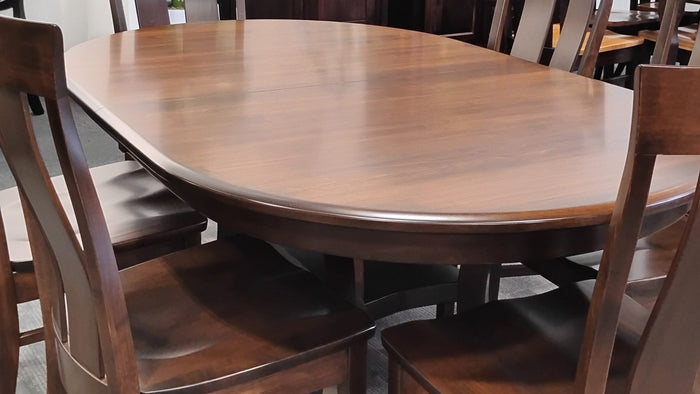
Trestles are the smallest group in our catalog. Three tables carry the name: the Hamden Trestle Table and the Raleigh Trestle Table both take up to four 12-inch leaves, while the Frontier Trestle Table comes without leaves in sizes from 36 x 36 to 60 x 60 inches. Some of our other tables use a trestle-style base too, like the dark base under the live edge table in the photo at the top of this guide.
Which table base seats the most people?
The base changes where people sit more than how many. Seat count comes mostly from the size of the top. The National Kitchen & Bath Association (NKBA) plans a space 24 inches wide and 18 inches deep for each person at a 30-inch-high table. Use that math first, then let the base decide the details:
- Need the odd extra chair often? A pedestal, single or double, gives you the most freedom to squeeze one in.
- Want people at the ends of a long table? Double pedestals and trestles keep the corners open. On a leg table, end seats sit between two legs, which works fine on a wide enough top.
- Using a bench on one side? Leg tables make it easy for the bench to slide under. On pedestal and trestle tables, check that the bench clears the feet or stretcher.
For seating counts by table size, see our dining table sizes guide. If you're planning leaves, our extension table guide covers how they work on each kind of table.
What do our customers actually choose?
This past year, leg tables and pedestal tables came up about equally often in what our customers chose, and pedestal choices split close to evenly between single and double. The Shaker Leg Table and the Wilson Single Pedestal Table were two of the tables our customers picked most often. Trestle tables were rare.
A simple way to read those numbers: the shape of the top usually leads. Round tops go on a pedestal, and long tops go on two pedestals or legs. A trestle is mostly a style choice, for people who love that long-table look.
Can you choose a different base for the same top?
Sometimes. Most of our furniture is made to order, and some tables list the base as an option. The Live Edge Table page offers two bases for the same slab top: a metal Eclipse base or a wooden Double X base. On most other tables, the base is part of the design, and a different look means a different table from the same builder.
If you've found a top you love but want a different base, ask us. We can check with the builder what is possible before you order.
How to decide in five minutes
- Start with the shape. Round or square: look at single pedestals first. Long rectangle or boat: double pedestal, legs or trestle.
- Count your everyday seats and your holiday seats. If the gap is big, choose a base that takes leaves; most of our double pedestal and leg tables take up to four.
- Think about your chairs. Arm chairs and wide upholstered chairs need open edges. Pedestals give you the most.
- Decide on a bench. A bench pairs most easily with a leg table.
- Sit at it. Pull a chair in, stretch your legs and check for feet, stretchers and corners. Call ahead or stop by one of our three showrooms, in Intercourse, Lancaster and Murrells Inlet, to try a few bases.
One table for each base
 Wilson Single Pedestal Table
 Delta Double Pedestal Table
 Shaker Leg Table
 Raleigh Trestle Table
Frequently asked questions
Which table base gives the most legroom?
A single pedestal leaves the whole edge open, so nobody sits next to a leg. The thing to check is the feet: on some designs, they spread out far enough to meet your toes or a chair leg.
Can a pedestal table seat a big family?
Yes. A large round on a single pedestal seats more than many people expect; one of our 60-inch rounds is listed as seating 8 to 10. For longer tables, a double pedestal with leaves grows with the family.
Do leg tables work with benches?
They do. The long sides are open between the legs, so a bench can slide under. Our builders tell us a bench meant to tuck between the legs usually runs about a foot shorter than the table.
What is the difference between a trestle table and a double pedestal table?
Both hold the top from two supports set toward the ends. A trestle uses a braced frame at each end, often joined by a low stretcher. A double pedestal uses two columns on spreading feet.
Are trestle tables hard to sit at?
Not usually, but the stretcher runs low between the ends, and some people rest their feet on it. Sit at one before you buy to see if it suits you.
Sources
- Encyclopaedia Britannica: Table (furniture)
- Merriam-Webster: pedestal table, trestle and trestle table
- National Kitchen & Bath Association: Kitchen Planning Guidelines with Access Standards (seating space)
- Product pages on kingsamishfurniture.com (bases, sizes, leaves and seating as listed in November 2026)
- Our showroom team's experience with customers (2026)
How we made this guide: we sorted the tables in our store by the base named in their titles and counted the sizes, shapes and leaves listed on those pages (as listed in November 2026), then added what our customers choose and ask our showroom team. Definitions and history come from Britannica and Merriam-Webster, and the seating space from the NKBA guidelines.
See it in person
Visit our showrooms in Intercourse and Lancaster, PA, and Murrells Inlet, SC. Open Monday to Friday 10 to 5, Saturday 9 to 5.