Solid Wood Furniture: Woods, Grades and How to Spot Real Wood
 By Michael King, Owner

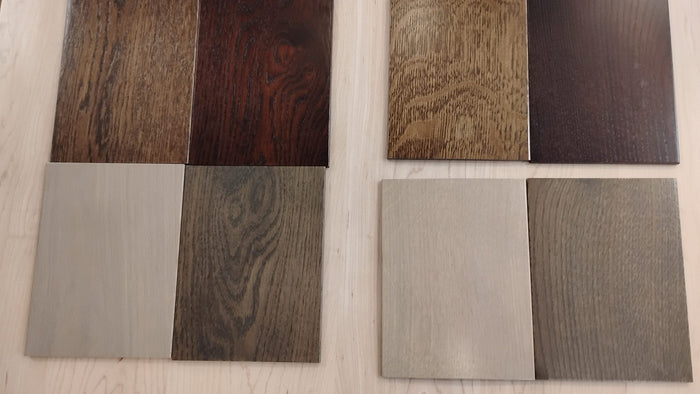
Solid wood furniture is built from boards of real lumber, not from a thin wood layer glued over particleboard or MDF. The common furniture hardwoods are oak, quarter sawn white oak, hickory, maple, cherry and walnut. They differ in hardness, weight, grain and color, and on our site most can be ordered in a clean grade or a rustic one with knots and character marks.
Key takeaways
- "Hardwood" is a botanical word. It means wood from broad-leaved, flowering trees like oak and maple, not wood that is always harder.
- Of the 3,546 product pages on our site, 3,303 let you pick the wood. The typical page lists 12 choices.
- Hickory is the hardest wood in our wood guide, quarter sawn white oak is next, and brown maple and cherry are the softer options.
- "Rustic," "sap" and "wormy" describe a look: they keep the knots, light sapwood or small marks that a clean grade avoids.
- To spot real wood, read the spec sheet, check the edges and the end grain, and look inside the drawers and at the back.
What is solid wood furniture?
Solid wood furniture is made from lumber that is wood all the way through. If you sand a scratch, you find more of the same wood under it.
Veneer is different: a thin slice of wood glued onto a core, often plywood, MDF or particleboard, which can't be sanded and refinished the same way. We cover the side-by-side checks in our guide to solid wood vs veneer vs MDF.
Hardwood vs softwood: it is about the tree
Merriam-Webster defines hardwood as the wood of a tree "producing flowers and having usually broad leaves," such as an oak or a maple. Softwood is the wood of a coniferous tree like pine or fir, "whether hard or soft." So the names describe the kind of tree, not how hard the board is.
What our own product pages say
Our site describes our indoor furniture as solid American hardwood and our outdoor furniture as maintenance-free poly. Across all 3,546 live product pages (November 2026), 46 spell out "solid wood" or "solid hardwood" for a part like sides, shelves or side rails, and 15 list a plywood part, such as a plywood back or plywood sides on a TV stand. None list veneer, MDF or particleboard.
What types of wood are used for solid wood furniture?
Six hardwoods make up the core of our wood guide. This table combines what our wood guide says about each one, the weights published by Purdue University Extension, and how many of our product pages offer it.
| Wood | Hardness and look (our wood guide) | Weight at 12% moisture (Purdue) | Our pages that offer it |
|---|---|---|---|
| Hickory | Hardest and heaviest of our options; fairly neutral color that works with warm or cool stains | Heavier than white oak | 2,756 (rustic hickory on 2,343) |
| Quarter sawn white oak | Second hardest; small stripes in the grain; neutral to slightly warm | About 47 lb per cubic foot (white oak) | 2,820 |
| Red oak | Middle of the hardness range; warmer tone; strong arch-shaped grain | About 44 lb per cubic foot | 3,277 (listed as Oak or Red Oak) |
| Brown maple | A softer hardwood; light, so it shows a wide range of stains; can show gray mineral streaks, so it does better with medium and dark finishes | Not listed in our sources (hard maple is about 44) | 3,164 |
| Cherry | Same hardness as brown maple; very smooth grain; noticeably red or pink tone | 34.9 lb per cubic foot | 3,071 |
| Walnut | Middle of the hardness scale; chocolate to purplish brown; darkens and deepens over time | About 38 lb per cubic foot | 2,244 |
Beyond these six, our pages also list elm (1,790 pages), hard maple (2,002), wormy maple (1,057), knotty alder (349) and, on a smaller number of pieces, reclaimed oak (148). One example: the Mission Bookcase offers 20 wood choices, from oak and brown maple to rift white oak and wormy maple.
Oak (red oak)
Oak is the wood listed most often on our site. Its strong, arch-shaped grain shows up in many traditional styles, and Purdue's red oak bulletin rates it very highly for planing, shaping and turning.
Hickory
Our wood guide calls hickory a popular wood for dining tables and other pieces that get frequent use. Purdue describes its look as "extremely variable," so expect more contrast from board to board than in maple or cherry.
Maple: brown maple and hard maple
Brown maple is a classic wood in Amish furniture and takes stain well. Hard maple is a different, denser maple: Purdue calls it one of the hardest and most uniformly grained species, with wide, white sapwood and darker brown heartwood.
Cherry
Purdue notes cherry is "relatively strong" for its weight. It also describes gum spots, small dark marks that form where a tree was wounded, and notes that veneer log buyers select against them. In a rustic cherry, small natural marks like these are part of the look.
Walnut
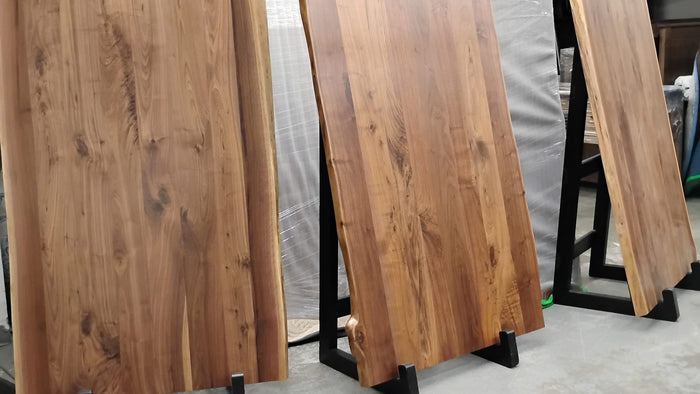
Walnut is the dark wood of the group. Our wood guide notes it can carry black, gray or even dark blue streaks, and Purdue calls it relatively strong for its weight.

What is the hardest wood for furniture?
Among the woods we offer, our wood guide ranks hickory as the hardest, then quarter sawn white oak, with red oak and walnut in the middle and brown maple and cherry as the softer options. The guide bases this on the Janka hardness test, which measures how much force it takes to dent a piece of wood. The higher the rating, the better the wood resists dings and scratches.
Hardness is one factor next to color, grain and finish. For a dining table that will see homework, crafts and holiday meals, it is worth leaning toward the harder end of the list. Our dining table guide goes into this in more detail.
What do wood grades like rustic, sap and wormy mean?
When you shop for solid wood furniture, the "grade" usually shows up as a choice between a clean look and a character look. On our product pages, the character options are listed as their own wood choices. Of the 3,303 pages with a wood list, 2,905 offer at least one rustic wood.
- Rustic (rustic cherry, rustic hickory, rustic quarter sawn white oak, rustic walnut): knots, color changes and small natural marks are part of the look. Rustic cherry is listed on 2,892 of our pages.
- Sap cherry: cherry that keeps its lighter sapwood next to the darker heartwood. Merriam-Webster describes sapwood as the outer part of the wood, "usually lighter in color than the heartwood." Sap cherry is listed on 2,302 of our pages.
- Wormy maple: maple with small marks and streaks left in the wood, listed on 1,057 of our pages.
- Knotty alder: alder with visible knots, listed on 349 pages.
A rustic grade is a style choice. If you would rather not worry about the odd ding, a rustic wood can also be forgiving, because small new marks tend to blend in with the character that is already there.

Quarter sawn vs flat sawn: why the same oak looks different
How a log is cut changes how the wood looks. Merriam-Webster defines quartersawn boards as "sawed from quartered logs so that the annual rings are nearly at right angles to the wide face." Flat sawn (also called plain sawn) boards are cut straight through the log, which shows the wide, arching grain most people think of as oak.
Purdue explains that oak has very large wood rays. A quarter sawn board is cut on a radius from the center of the log toward the bark, parallel to those rays, which exposes them as the flecked pattern quarter sawn white oak is known for. In a rift cut, the rays are crossed at about a 45 degree angle. Purdue also notes that quartered and rift white oak were used for Arts and Crafts and Mission style furniture, which is why the look still goes with those styles.
On our site, quarter sawn white oak (standard grade) appears on 2,820 pages, flat sawn white oak on 726 and rift white oak on 69.
How can you tell if furniture is real solid wood?
No tools needed. Five checks that work in any store:
- Read the spec sheet. Look for the wood species and for words like veneer, laminate, MDF, particleboard or "engineered wood."
- Look at the edge of the top. On solid wood, the grain wraps around the edge and the ends show end grain. A thin line or a repeating pattern points to veneer or a printed layer.
- Compare the top and the underside. Solid wood shows the same kind of grain on both faces. A plain, gray or flaky underside usually means a composite core.
- Open a drawer and look at the back. Check the drawer sides and the back panel, where many makers use a thinner material.
- Ask. The store should be able to tell you which parts are solid wood.
For more detail on each material, see our guide to solid wood vs veneer vs MDF.
How do you choose the right wood for your furniture?
- Heavy daily use (dining tables, kids' rooms): lean toward hickory or quarter sawn white oak, the harder woods in our guide.
- A warm, traditional look: cherry or red oak. Cherry brings a red tone of its own, so test light stains on it.
- A very light or near-white finish: ask to see the stain on the wood first, or consider paint. Brown maple can show mineral streaks and, as our team has seen, a slight pink cast under very light stains.
- A dark, rich look without a heavy stain: walnut, which our wood guide says darkens and deepens over time.
- Character and a relaxed feel: a rustic grade of cherry, hickory, oak or walnut, or wormy maple.
Stain changes each wood in its own way, so see our guide to Amish stain colors next. You can also browse our furniture by room.
Pieces you can order in your choice of wood
 Mission Bookcase
 Lynnwood Panel Bed
 Live Edge Table
 Brantley Leg Table
Frequently asked questions
Is hardwood furniture always harder than softwood furniture?
Not always. "Hardwood" and "softwood" describe the kind of tree. Hardwoods come from broad-leaved, flowering trees and softwoods from conifers like pine. The furniture hardwoods, such as oak, hickory and maple, happen to be dense and durable as well.
What does QSWO mean?
QSWO is short for quarter sawn white oak: white oak cut so the growth rings run nearly at right angles to the face of the board. It shows a striped, flecked grain and, in our wood guide, it is the second hardest option after hickory.
What is sap cherry?
Sap cherry is cherry that keeps some of the lighter sapwood next to the darker heartwood, so one board can show two tones. It is listed as its own wood choice on 2,302 of our product pages, separate from cherry and rustic cherry.
Does solid wood change color over time?
It can. Our wood guide notes that walnut darkens and deepens over time. Our care guide covers sunlight, humidity and cleaning, which all affect how a finish ages.
Is solid wood furniture worth it?
If you want a piece you can repair, refinish and keep for a long time, solid wood is worth a look. It usually costs more up front than particleboard or MDF, but a scratch in solid wood can be sanded out because the same wood runs all the way through.
Sources
- Merriam-Webster: hardwood
- Merriam-Webster: softwood
- Merriam-Webster: sapwood
- Merriam-Webster: quartersawn
- Purdue Extension, Hardwood Lumber and Veneer Series: Red Oak (FNR-288-W)
- Purdue Extension, Hardwood Lumber and Veneer Series: White Oak (FNR-292-W)
- Purdue Extension, Hardwood Lumber and Veneer Series: Hickory and Pecan (FNR-285-W)
- Purdue Extension, Hardwood Lumber and Veneer Series: Hard or Sugar Maple (FNR-287-W)
- Purdue Extension, Hardwood Lumber and Veneer Series: Black Cherry (FNR-276-W)
- Purdue Extension, Hardwood Lumber and Veneer Series: Black Walnut (FNR-278-W)
- Kings Amish Furniture wood guide
- Product pages on kingsamishfurniture.com (wood choices and materials as listed in November 2026)
How we made this guide: we read the wood choices and material notes on all 3,546 live product pages on our site and counted them, compared them with our wood guide, read the dictionary entries and Purdue Extension bulletins above, and reviewed questions customers ask our team about wood. Every fact was checked against our product pages.
See it in person
Visit our showrooms in Intercourse and Lancaster, PA, and Murrells Inlet, SC. Open Monday to Friday 10 to 5, Saturday 9 to 5.