Types of Bed Frames: Panel, Sleigh, Platform, Post and More
 By Michael King, Owner

The main types of bed frames are panel, sleigh, slat (or mission), post and canopy, platform, storage, upholstered, captain's, wall (Murphy) beds, and bunk or loft beds. They differ in three ways: the shape of the headboard and footboard, what holds the mattress up, and what sits under the bed. Pick the support first, then the style.
Key takeaways
- Style names (panel, sleigh, slat, post) describe the headboard and footboard. Support names (platform, slats, box spring) describe what the mattress rests on. A bed has one of each.
- A platform bed has a built-in foundation, so it doesn't need a box spring. Many slat beds don't either, but the answer changes from bed to bed.
- Sleigh beds look grand but take more floor length. On our site, 46 bed pages offer a low or short footboard option.
- Ask three questions before you buy: how is the mattress supported, how high will it sit, and do you want drawers or open floor under the rails?

What is a bed frame?
A bed frame is the structure that holds your mattress off the floor. Most wood bed frames have four parts: a headboard, a footboard, two side rails that connect them, and some kind of support across the rails for the mattress. That support can be wood slats, a solid deck, or a box spring.
When people talk about "types" of bed frames, they usually mean one of two things. Some names describe the look, like a sleigh bed or a post bed. Others describe how the bed works, like a platform bed or a storage bed. One bed can be both: a panel bed with drawer units, for example, or a post bed with a canopy.
What are the main types of bed frames?
Here is a quick comparison. The last column counts the bed pages on our site with that word in the product name, as listed in November 2026. Names overlap, so the counts don't add up to a total.
| Type | What defines it | Good fit for | Bed pages on our site |
|---|---|---|---|
| Panel bed | Flat or raised wood panels in the headboard and footboard | Most rooms; easy to match with dressers | 39 |
| Sleigh bed | Headboard and footboard that roll outward at the top | Larger rooms and traditional looks | 10 |
| Slat or mission bed | Rows of upright boards in the headboard | Craftsman and farmhouse rooms | 8 slat, 16 mission |
| Post bed | Tall corner posts, often turned or tapered | Rooms with taller ceilings | 6 |
| Canopy bed | A frame over the posts for fabric | A statement bedroom | 1 |
| Platform bed | A built-in foundation for the mattress | Skipping the box spring | 2 |
| Storage bed | Drawers in the side rails or footboard | Small rooms and guest rooms | 28 |
| Wall (Murphy) bed | Folds up into a cabinet | Studios and home offices | 2 |
| Bunk and loft beds | Stacked or raised sleeping space | Kids' rooms and shared rooms | 8 bunk, 8 loft |
Panel beds
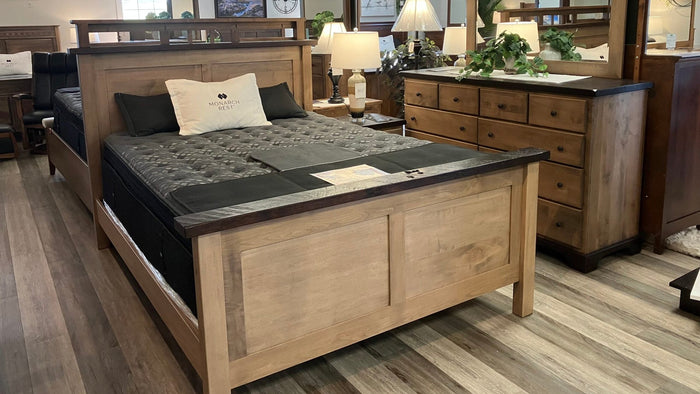
A panel bed has a headboard and footboard built as a frame around flat or raised wood panels. It is the most common style name in our bed collection, and it suits almost any room. The look changes a lot with the panel shape, the top rail (straight, arched or crowned) and the wood. If you want a bed that sits quietly with a matching dresser, start with our panel beds.
Sleigh beds
Merriam-Webster defines a sleigh bed as a bed "having a solid headboard and footboard that roll outward at the top," and notes it was common especially in the first half of the 19th century. That outward curve is the whole idea: from the side, the bed looks a little like a horse-drawn sleigh.
The curve has a cost in space. A rolled footboard adds length, so measure your walkway at the foot of the bed. If you like the curved headboard but not a tall footboard, look for a low footboard option. The Tucson Sleigh Bed, for example, lists a 33-inch footboard on its product page, and several of our other beds offer a low version. You can see all of our sleigh beds in one place.
Slat and mission beds
A slat bed has a headboard (and sometimes a footboard) made of evenly spaced upright boards. Mission beds use the same idea with heavier, straight lines. These styles come from the Arts and Crafts tradition; our mission style furniture guide covers how to spot the real look. Don't confuse a "slat bed" style with the slats under the mattress. Almost every wood bed has those.

Post beds and canopy beds
Merriam-Webster describes a four-poster as "a bed with tall often carved corner posts originally designed to support curtains or a canopy." Today the posts are mostly decorative. Pencil post beds have thin, tapered posts; other post beds use thick turned posts. A canopy bed adds a frame on top of the posts for fabric. On our site, the Hamilton Pencil Post Bed lists posts 84 inches tall, and its canopy version adds the frame on top. Check your ceiling height before you fall for one.

Storage beds
A storage bed puts drawers where you would otherwise have empty space: in the side rails, or in the footboard. On several of our storage beds you can choose drawer units that run to the floor or drawer units raised a few inches, which leaves a gap for sweeping. Some beds offer two drawers in the footboard instead. Browse our storage beds, and see our guide to kids' storage beds, trundles and bunks for children's rooms.

Upholstered, captain's, wall and day beds
An upholstered bed covers the headboard in fabric or leather; the Camden bed on our site pairs a wood frame with leather upholstery. A captain's bed is a raised bed with drawers underneath; our Captains Bed adds a bookcase headboard. A wall bed, which Merriam-Webster calls a Murphy bed, is "a bed that may be folded or swung into a closet." Both wall beds on our site list a recommended mattress thickness of 10 inches and note that you will need a contractor to install them. A daybed works as a sofa by day and a bed at night.
Platform bed vs regular bed: what's the difference?
The difference is the support under the mattress. Merriam-Webster defines a platform bed as a bed whose frame "includes a built-in foundation to support the mattress." That foundation does the job a box spring would do on a traditional bed.
A "regular" bed frame, in the old sense, holds a box spring on the rails, and the mattress goes on top of the box spring. Many solid wood beds today sit in between: wood slats across the rails support the mattress directly. On our site, 48 bed pages say the bed has four slats for the mattress to sit on, and many of those pages also list center supports (two on a queen, four on a king).
| Platform bed | Slat bed frame | Frame with box spring | |
|---|---|---|---|
| What holds the mattress | Built-in deck or foundation | Wood slats across the rails | Box spring on the rails |
| Box spring needed? | No | Depends on the bed and mattress | Yes |
| Overall height | Usually lower | Medium | Taller |
| Under-bed space | Often drawers or a closed base | Often open | Often open |
Do bed frames need a box spring?
Not always. It depends on how the bed supports the mattress. On our site, 12 beds with drawer units say outright that no box spring is needed. For slat beds, the answer depends on the bed and on your mattress, so check two things: what the bed's product page says about slats and supports, and what your mattress maker asks for. Your mattress warranty may depend on the right support.
Height matters too. Leaving out a box spring lowers the bed, which some people like and some don't. Add your mattress thickness to the height of the slats or deck to see where you will sit. Our bedroom furniture guide lists the slat heights on our beds and how to match a nightstand to them.
How do you choose the right type of bed frame?
Start with the room
Measure the wall for the headboard and the walkway at the foot. Sleigh and post beds need more room than a simple panel bed. A low footboard, or no footboard at all, makes a small room feel bigger. For a king, our king bedroom set guide covers room sizes in detail.
Decide what goes under the bed
Do you need storage, or do you want open floor you can clean? Drawers add storage but need clear space beside the bed to open. On 34 of our bed pages, the product listing gives the open space under the side rails for sweeping.
Pick the style last
Once the size and support are settled, choose the look that suits the rest of the room. Panel beds match easily with a dresser; sleigh and post beds become the focal point. What our customers choose leans practical: over the past year, only a few of the beds our customers picked were sleigh beds, and beds with drawer storage came up more often.
Ready to compare? Browse all beds, or see the whole bedroom collection.
Beds from our bedroom collection
 Tucson Sleigh Bed
 Williamsport Slat Bed
 Redmond Wellington Panel Bed W/ Drawer Units To The Floor
 Hamilton Pencil Post Bed
Frequently asked questions
What is the most common type of bed frame?
In our own bed collection, panel beds are the most common style name, with 39 bed pages. They suit most rooms and match easily with other bedroom pieces.
Is a sleigh bed out of style?
Sleigh beds are a traditional look; Merriam-Webster notes they were common in the first half of the 1800s. They still suit larger, classic rooms. If you want the curve without the bulk, look for a low footboard version.
What is the difference between a platform bed and a regular bed?
A platform bed has a built-in foundation, so it doesn't need a box spring. A traditional frame holds a box spring, and the mattress sits on top of it.
Do wood slat beds need a box spring?
It depends on the bed and the mattress. Check the bed's product page for its slats and center supports, then ask your mattress maker what support it calls for.
How much ceiling height does a post bed need?
Measure the posts on the product page. The Hamilton Pencil Post Bed on our site lists 84-inch posts, so it needs a ceiling well above that to look right.
Sources
- Merriam-Webster: sleigh bed
- Merriam-Webster: platform bed
- Merriam-Webster: four-poster
- Merriam-Webster: canopy bed
- Merriam-Webster: Murphy bed
- Product pages on kingsamishfurniture.com (names, sizes and options as listed in November 2026)
- Our showroom team's experience with customers (2026)
How we made this guide: we counted the bed styles, footboard options and support details listed on the bed pages in our collection (as listed in November 2026), compared them with the dictionary definitions above, and shaped the questions around what customers ask our team about beds.
See it in person
Visit our showrooms in Intercourse and Lancaster, PA, and Murrells Inlet, SC. Open Monday to Friday 10 to 5, Saturday 9 to 5.