Types of Wood for Furniture: Oak, Cherry, Maple, Walnut, Hickory
 By Michael King, Owner

Most solid wood furniture is built from a handful of North American hardwoods: hickory, white oak, red oak, maple, cherry and walnut. Hickory is the hardest, and cherry and brown maple are the softer options. Oak and hickory hide scratches best, cherry and maple feel smooth, and walnut is the naturally dark one. Pick by how hard the piece will work, then by color and grain.
Key takeaways
- Hardness, measured by the Janka test, ranges from about 950 pounds-force for black cherry to 1,880 for shagbark hickory in the U.S. Forest Service's Wood Handbook. Hickory takes about twice the force to dent.
- Busy grain hides everyday marks. Oak and rustic hickory are more forgiving on a family table than smooth cherry or maple.
- Color changes with time: cherry darkens a lot in light, and walnut deepens.
- Most of our furniture is made to order, and a typical product page on our site offers 12 wood choices, so the same design can look very different.
- Judge wood on a real sample in your own light, not on a screen.
What are the main types of wood used for furniture?
Furniture woods fall into two groups: hardwoods, from broadleaf trees like oak and maple, and softwoods, from conifers like pine. Our indoor furniture is solid hardwood. Our wood guide covers six core woods: red oak, quarter sawn white oak, hickory, brown maple, cherry and walnut. Many of our pages add more, such as hard maple, elm, wormy maple and rustic grades of the core woods.
If you are still deciding between solid wood and other materials, start with our guide to solid wood furniture, wood grades and how to spot real wood. This page goes one step further: how the woods compare, and which one fits the way you live.
How do the furniture woods compare?
The table puts each wood's lab hardness next to how it looks. The hardness numbers come from Table 5-3b of the U.S. Forest Service's Wood Handbook. They are side hardness at 12% moisture, measured with a modified Janka test: the force needed to press a small steel ball halfway into the wood. A higher number means the wood resists dents better.
| Wood | Janka hardness (Wood Handbook) | Look | A good fit when |
|---|---|---|---|
| Hickory | 1,880 lbf (shagbark hickory) | Strong light and dark contrast, fairly neutral tone; rustic hickory keeps small knots and marks | The table works hard every day and you like character |
| Hard maple | 1,450 lbf (sugar maple) | Very fine, even grain; pale | You want a smooth, light, dense surface |
| Quarter sawn white oak | 1,360 lbf (white oak) | Straight grain with small stripes and flecks; neutral to slightly warm | Mission or Craftsman style, daily use |
| Red oak | 1,290 lbf (northern red oak) | Strong arch-shaped grain; warmer tone | Traditional looks and a forgiving surface |
| Walnut | 1,010 lbf (black walnut) | Chocolate to purplish brown; darkens and deepens over time | A statement piece with natural dark color |
| Cherry | 950 lbf (black cherry) | Very smooth grain; red or pink tone that darkens in light | Bedrooms, formal rooms and a smooth look |
| Brown maple | Not listed by that name; our wood guide rates it as hard as cherry | Light, smooth; can show gray mineral streaks | You want a medium or dark stain on a smooth wood |
Two notes on the numbers. They are averages from small, clear test pieces, so a single board can be harder or softer. And hardness is only one part of how a piece wears: the finish, the grain pattern and how the piece is used matter too. The Wood Handbook lists red maple, a soft maple, at 950, the same as black cherry, which matches where our wood guide places brown maple.

Which wood is the hardest, and does it matter?
Of the woods above, hickory is the hardest. Shagbark hickory needs about twice the force to dent as black cherry (1,880 versus 950). Purdue University Extension calls hickory "our most dense and strongest North American hardwood lumber category." Our wood guide ranks hickory first and quarter sawn white oak second, with red oak and walnut in the middle and brown maple and cherry as the softer options.
Hardness matters most on surfaces that take hits: dining tables, kitchen islands, desks and kids' furniture. It matters less on a bed, a hutch or a dresser. A softer wood is not a weak wood. Cherry and walnut have been used for fine furniture for centuries. They just show dents a little sooner on a busy table.
Oak: red oak and quarter sawn white oak
Oak is the most familiar furniture wood. Red oak has a bold, arch-shaped grain and a warmer tone. Our wood guide calls it a common option because it is often readily available. Quarter sawn white oak is cut so the grain runs in straight lines with small stripes and flecks, the look you see on Mission and Craftsman pieces.
Oak's open grain is its practical strength. The pattern is busy enough that small scratches and dents blend in. For a side-by-side look at color, pores and flecks, see our red oak vs white oak guide.
Hickory: the hardest and the most varied
Hickory has the highest hardness rating in our wood guide and is the heaviest. Purdue Extension notes that its heartwood runs from pale brown to reddish brown, with white sapwood that can be several inches wide. That mix is why hickory furniture shows strong highlights and lowlights from board to board. Rustic hickory keeps small knots, bird peck and other natural marks, which Purdue says are often left in to give a rustic accent.
Our wood guide notes that hickory tends to stay fairly neutral, so it works with both warm and cool stain colors. It has long been a popular wood for dining tables and other pieces that get daily use.
Maple: brown maple and hard maple
Brown maple is a classic wood in Amish furniture and a softer hardwood. It is light, so it shows the color of a stain clearly. It can carry gray mineral streaks, which is why our wood guide says it does better with medium and dark finishes.
Hard maple is a different, denser maple. Purdue describes it as one of the hardest and smoothest species, with pores so small you cannot see them. The same bulletin warns that over-sanded maple can be difficult to stain, If you want a pale, smooth surface that resists dents, hard maple is worth a look. It is offered on about 2,000 of our product pages.
Cherry: smooth grain that darkens
Cherry has a very smooth, fine grain with a red or pink undertone. Purdue Extension says freshly cut cherry heartwood ranges from very light pink to dark red brown and "darkens substantially with exposure to light." Purdue gives a familiar example: pictures hung on a new cherry wall, when taken down years later, leave lighter patches behind. Expect the same on a cherry dresser top where a lamp or tray sits in one spot. Move things around now and then while the wood is new.
Cherry is as hard as brown maple in our wood guide, so it can scratch a little more easily than oak or hickory. Many people choose it anyway for its smooth look. Rustic cherry and sap cherry are also listed on many of our pages; they keep more of the natural marks and the lighter sapwood.
Walnut: the dark one
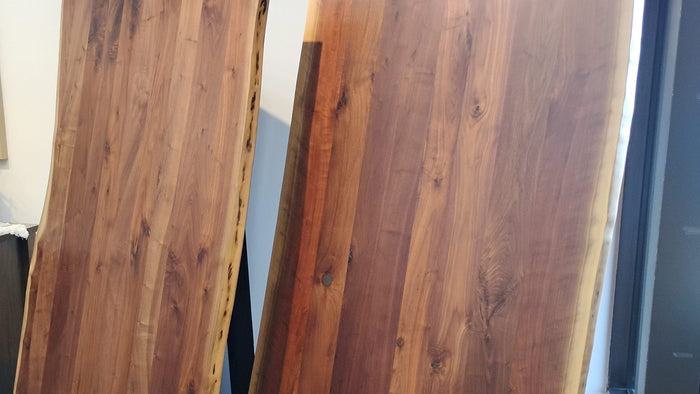
Walnut is the naturally dark wood of the group. Purdue Extension describes its heartwood as a chocolate brown "not duplicated by any other species," with a grain between grainy woods like oak and even-textured woods like maple. Our wood guide adds that it ranges from rich chocolate to purplish brown, sometimes with black, gray or dark blue streaks, and that it darkens and deepens over time.
At 1,010 pounds-force, walnut sits in the middle of the hardness range. Walnut also shows up a lot on our live edge tables and benches, where the natural edge of the slab is left on.

What other woods will you see on furniture pages?
Beyond the six core woods, our product pages list several others. Elm appears on about 1,800 pages; the Wood Handbook puts American elm at 830 pounds-force, softer than cherry. Wormy maple and knotty alder are named for the natural marks they keep. Rustic versions of oak, cherry, hickory and walnut keep knots and natural marks that select grades leave out. For what rustic, sap and wormy mean, see the wood grades section of our solid wood guide.
How many choices you get depends on the piece. The Camden 3 Drawer Nightstand lists 12, which is also the typical number across our site. The Hickory Grove 2 Drawer Nightstand is offered in 8 woods, including red oak, cherry and quarter sawn white oak, despite the name. The Mission Bookcase lists 20.

Which wood should you choose for your home?
Start with how the piece will be used, then narrow by look.
- A family dining table or kitchen island: hickory, quarter sawn white oak or red oak. They are harder, and their grain hides daily marks.
- A smooth, refined look: cherry or hard maple. Plan on a few more visible marks over time if it is a working table.
- Natural dark color without a dark stain: walnut.
- A medium or dark stain on a smooth wood: brown maple.
- A light, cool or gray finish: hickory and quarter sawn white oak are fairly neutral, so they work with both warm and cool colors. Ask to see your stain on a sample first.
- Matching furniture you already own: bring a drawer or a leaf to the showroom and compare it to real samples.
So what do people actually pick? Over the past year, brown maple has come up more often than any other wood in the furniture our customers order. Oak, walnut, rustic cherry and hickory each come up regularly too. Much of the walnut goes into live edge tabletops.
The stain changes the picture too. The same color can look quite different on oak's open grain than on smooth maple or cherry. Our guide to Amish stain colors shows how wood and stain work together.
Pieces you can order in different woods
 Hickory Grove 2 Drawer Nightstand
 Camden 3 Drawer Nightstand
 Mission Bookcase
Frequently asked questions
What is the best wood for furniture?
There is no single best wood. For a table that works hard, hickory and oak are the most forgiving. For a smooth, elegant look, cherry and maple. For natural dark color, walnut. Choose by use first, then by color and grain.
Is maple or oak better for furniture?
It depends on the maple. Hard maple tests harder than oak in the Wood Handbook (1,450 versus 1,290 to 1,360 pounds-force). Brown maple is softer, about as hard as cherry. Oak's open grain hides scratches better; maple's smooth surface shows them more but gives a cleaner look.
Which wood is most scratch resistant?
Of the woods in this guide, hickory is the hardest. In daily life, grain matters too: a busy grain like oak or rustic hickory hides small scratches that would show on smooth cherry or maple. The finish plays a part too.
Does cherry wood darken over time?
Yes. Purdue Extension says cherry darkens substantially with exposure to light. Objects left in one place can leave lighter spots, so move lamps and decor now and then while the wood is new.
Is walnut harder than oak?
No. In the Wood Handbook, black walnut rates 1,010 pounds-force, while northern red oak rates 1,290 and white oak 1,360. Walnut still handles daily use well; it sits in the middle of our wood guide's hardness range.
Can I choose the wood for my furniture?
Yes. Our FAQ lists wood type among the customization options, along with stain color, hardware and dimensions. Each product page lists the woods offered for that piece, and our team can help you compare them on real samples.
Sources
- USDA Forest Service, Forest Products Laboratory: Wood Handbook, Chapter 5, Mechanical Properties of Wood (Table 5-3b)
- Purdue Extension, Hardwood Lumber and Veneer Series: Hickory and Pecan Species (FNR-285-W)
- Purdue Extension, Hardwood Lumber and Veneer Series: Hard or Sugar Maple (FNR-287-W)
- Purdue Extension, Hardwood Lumber and Veneer Series: Black Cherry (FNR-276-W)
- Purdue Extension, Hardwood Lumber and Veneer Series: Black Walnut (FNR-278-W)
- Kings Amish Furniture wood guide
- Kings Amish Furniture FAQ
- Product pages on kingsamishfurniture.com (wood choices as listed in November 2026)
- Our showroom team's experience with customers (2026)
How we made this guide: we took the hardness numbers from the Wood Handbook table and the wood descriptions from the Purdue bulletins linked above, compared them with our own wood guide, and counted the wood choices listed on our product pages, including the three pieces linked in this guide.
See it in person
Visit our showrooms in Intercourse and Lancaster, PA, and Murrells Inlet, SC. Open Monday to Friday 10 to 5, Saturday 9 to 5.