Red Oak vs White Oak Furniture: Color, Grain, Hardness and Cost
 By Michael King, Owner

Red oak and white oak are both strong, open-grained hardwoods, and both make solid furniture. Red oak has a warmer, slightly pink tone, a bold arching grain and open pores. White oak is a little heavier and harder, browner in tone, with a calmer grain and pores that are plugged. Quarter sawn white oak adds the flecked figure Mission furniture is known for.
Key takeaways
- Color is the quickest tell: red oak leans pink to reddish, white oak leans straw to light brown.
- White oak is the heavier wood (about 47 lb per cubic foot vs about 44 for red oak, per Purdue Extension), and our wood guide ranks quarter sawn white oak above red oak for hardness.
- White oak's pores are filled with growths called tyloses, which is why it is used for barrels. Red oak's pores stay open.
- On our product pages, red oak is usually listed simply as "Oak", and white oak shows up as QSWO (quarter sawn), flat sawn or rift.
- Of the 3,303 pieces on our site with a wood list, 3,025 can be ordered in either red oak or white oak (as listed in November 2026).
What is the difference between red oak and white oak?
"Red oak" and "white oak" are not single trees. They are two groups of oak species that the lumber trade sorts into two categories. Purdue Extension's hardwood bulletins say the red oak category can include as many as 17 species, with northern red oak as the preferred one, and the white oak category as many as eight eastern species. Together, the two groups make up 48 percent of all hardwood lumber produced in the United States, according to Purdue.
You can tell the trees apart in the yard, too. Encyclopaedia Britannica explains that white oaks have smooth leaves without bristle tips and acorns that mature in one season. Red and black oaks have bristle-tipped leaves, and their acorns mature at the end of the second season.
Once the wood is cut, dried and built into a dresser or a table, here is how the two compare:
| Red oak | White oak | |
|---|---|---|
| Natural color | Very light pink to deep red (Purdue) | Light straw to brown, sometimes mottled with gray (Purdue) |
| Grain | Showy, coarse, strong arch-shaped grain | Coarse but "somewhat more subdued" than red oak (Purdue) |
| Pores | Open; red oak "normally lacks or has limited tyloses" | Plugged with tyloses, which makes the wood impermeable to liquid movement |
| Weight at 12% moisture | About 44 lb per cubic foot | About 47 lb per cubic foot |
| Hardness in our wood guide | Middle of the range, "handles tough use well" | Quarter sawn white oak is the second hardest option, after hickory |
| Ray fleck when quarter sawn | Present | Larger; Purdue notes white oak "will have the largest ray fleck" |
| How it is listed on our pages | "Oak" (sometimes "Red Oak") | QSWO, flat sawn white oak (FSW), rift white oak, and rustic versions |
| Cost on our pages | The lower of the two | Higher; on all 60 pages we sampled that list both, QSWO cost more than oak |
The price point comes from our own catalog: we took a random sample of 60 product pages that offer both "Oak" and "QSWO" and compared the two options for the same size and setup. Quarter sawn white oak cost more on every one of them. That matches Purdue's note that quarter and rift sawn white oak "is a specialty item and commands a substantial premium compared to standard lumber."
Is red oak or white oak harder?
White oak is the harder and heavier of the two, but the gap is not huge. Purdue puts red oak at about 44 pounds per cubic foot and white oak at about 47, both at 12 percent moisture. Our wood guide uses the Janka hardness test, which measures how much force it takes to dent a piece of wood. It ranks hickory as the hardest wood we offer, quarter sawn white oak second, and red oak in the middle, where it "handles tough use well." Brown maple and cherry sit on the softer end.
In daily life, the grain matters as much as the hardness number. Both oaks have a busy, open grain, and that pattern helps hide the small dents and scratches every table and dresser picks up. A smooth, tight-grained wood like cherry or maple shows a scratch more readily, even if it is never abused. If you have kids, pets or a dining table that doubles as a homework desk, either oak is a forgiving choice, and white oak gives you a little more dent resistance.
Both woods are also easy for a builder to work. Purdue rates red oak very highly for planing, shaping and turning, and says white oak "tends to cut clean without tearing or fuzzying." That is part of why oak shows up in so many traditional furniture styles.

How can you tell red oak from white oak?
On finished furniture, a dark stain can hide most of the clues. On natural or light finishes, look at three things:
1. The color
Red oak usually has a pink or reddish cast, even under a clear coat. Purdue describes red oak color running "from a very light pink, which is currently preferred, to a blood red color." White oak runs from light straw to brown. It is not a perfect test: Purdue notes that slow-growing old white oak trees occasionally produce boards with a pink color, "very similar to red oak."
2. The pores
Both oaks are ring porous: each spring the tree makes large pores you can see with the naked eye, then switches to small, dense ones. In white oak, those large pores are filled with tyloses, tiny growths that block them. Purdue says that on a freshly cut surface the tyloses "will glisten as light reflects off their surface." In red oak the pores stay open. This is also why white oak is used for whiskey barrels and wine casks and red oak is not.
3. The flecks and the grain pattern
All oaks have large wood rays, ribbons of cells that run from the center of the log out toward the bark. When oak is quarter sawn, the cut runs along those rays and shows them as flecks across the face of the board. White oak has the larger, showier ray fleck. Flat sawn red oak, on the other hand, shows the wide, arching "cathedral" pattern most people picture when they think of oak.
When you shop with us, you don't need to guess. Each product page lists its wood choices by name, and the "Shown With" line under the description says which wood is in the photo.
What is quarter sawn white oak, and how is it different from flat sawn and rift?
All three are white oak. The difference is how the log is cut, which changes the look of the board:
- Quarter sawn (QSWO): cut on a radius from the center of the log to the bark, parallel to the rays. Merriam-Webster defines quartersawn boards as "sawed from quartered logs so that the annual rings are nearly at right angles to the wide face." The result is a straight grain with flecks across it.
- Flat sawn (FSW, also called plain sawn): cut straight through the log. It shows the arching grain, with only the ends of the rays visible.
- Rift: the rays are crossed at about a 45 degree angle. Purdue describes the look as "pencil stripped," with very little fleck.
On our site, quarter sawn white oak is offered on 2,808 pieces and rustic quarter sawn white oak on 2,696. Flat sawn white oak appears on 512 pieces and rift white oak on 69 (as listed in November 2026). For more on how saw cuts change the look of any board, see the quarter sawn vs flat sawn section of our solid wood guide. If you love the flecked look, our guide to why Mission furniture uses quartersawn white oak covers the history behind it.

Does red oak look pink?
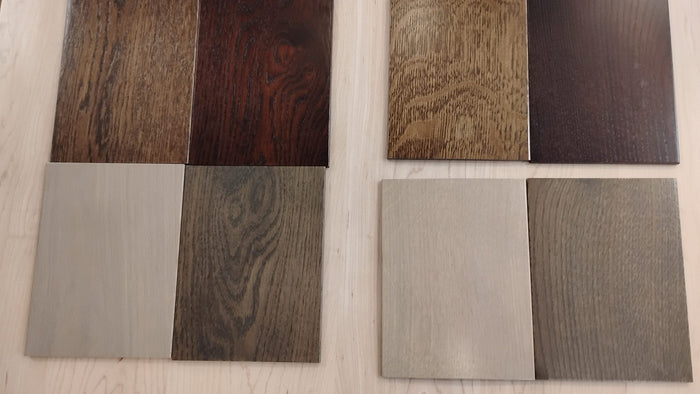
Often, yes, and that is the main reason people choose one oak over the other. Red oak's natural pink to red tone shows through clear finishes and very light stains. With medium and dark stains, the tone blends in and the grain pattern becomes the bigger difference.
If you want a light, natural or "white oak" look, start with white oak rather than trying to stain red oak lighter. If you like a warm, traditional look with lots of grain, red oak gives you that at a lower cost.
Very light stains are tricky on every wood, not just oak. Before you decide, look at a real stain sample on the wood you plan to order. A sample on red oak and the same color on white oak can look quite different. You can request free stain samples, and our guide to Amish stain colors walks through the common choices.
Which oak is better for furniture?
Neither is better across the board. Both are sturdy, Amish-made furniture woods that last for decades with normal care. The right choice depends on what you want the piece to look like and how much you want to spend.
| If you want... | Lean toward | Why |
|---|---|---|
| The lower-cost oak | Red oak | It was the lower-priced option on every page in our sample |
| A warm, traditional look with bold grain | Red oak | Our wood guide describes its "strong arch-shaped grain that is seen in many traditional styles" |
| A light or natural finish without pink | White oak | Its natural color runs straw to brown |
| Mission, Craftsman or Arts and Crafts style | Quarter sawn white oak | Purdue notes quartered and rift oak was commonly used in Mission and Arts and Crafts furniture |
| Extra dent resistance for a busy table | Quarter sawn white oak (or hickory) | They rank first and second for hardness in our wood guide |
| Knots and character marks | Rustic quarter sawn white oak | Offered on 2,696 pieces on our site |
One point that often comes up online: white oak is more resistant to decay than red oak, and Purdue lists it for fence posts, trailer beds and other outdoor uses. For indoor furniture with a good finish, decay is not the issue it is for a fence post, so you don't need white oak just for that reason.
Can you order the same piece in red oak or white oak?
Almost always. Most of our furniture is made to order, so the wood is a choice you make, not something fixed by the photo. Of the 3,303 pieces on our site with a wood list, 3,025 offer both red oak and at least one kind of white oak. Only 88 offer red oak without white oak, and 54 offer white oak without red oak (as listed in November 2026).
The Old English Mission collection is a good example. The pieces in the photo above come from the same line, and each page lets you pick oak, QSWO or rustic QSWO, along with other woods. The Bunker Hill Table from Hermie's Table Shop goes further: its wood list includes oak, QSWO, rustic QSWO, flat sawn white oak and rustic flat sawn white oak.
Pieces you can order in red oak or white oak
 Old English Mission 72'' Dresser
 Old English Mission 56'' Low Dresser
 Bunker Hill Table
 Computer Rolltop Desk – 60"W
Frequently asked questions
Is white oak more expensive than red oak?
On our site, yes. In a random sample of 60 product pages that offer both, the quarter sawn white oak option cost more than oak on every one. Purdue also notes that quarter and rift sawn white oak lumber commands a substantial premium.
Is red oak good for furniture?
Yes. Red oak is strong and heavy (about 44 pounds per cubic foot, per Purdue), it sits in the middle of the hardness range in our wood guide, and its open grain hides everyday wear well. It is also the lower-cost oak on our pages.
Is white oak waterproof?
No wood is waterproof. White oak's pores are blocked by tyloses, which is why it holds liquid well enough for barrels. Furniture still needs its finish, coasters and a quick wipe when something spills.
What does "Oak" mean on your product pages?
On most of our pages, "Oak" is red oak. White oak is listed by its cut: QSWO (quarter sawn white oak), FSW or flat sawn white oak, and rift white oak, plus rustic versions with knots and character marks.
What is rift white oak?
Rift white oak is cut so the saw crosses the wood rays at about 45 degrees. Purdue describes the result as "pencil stripped," a straight, even grain with very little fleck. It appears on 69 pieces on our site.
Sources
- Purdue Extension, Hardwood Lumber and Veneer Series: Red Oak (FNR-288-W)
- Purdue Extension, Hardwood Lumber and Veneer Series: White Oak (FNR-292-W)
- Encyclopaedia Britannica: Oak
- Merriam-Webster: "quartersawn" definition
- Product pages on kingsamishfurniture.com (as listed in November 2026)
- Our showroom team's experience with customers (2026)
How we made this guide: we counted the wood choices on every live product page on our site and compared the oak and QSWO options on a random sample of 60 pages (as listed in November 2026), then paired those counts with our wood guide, the Purdue Extension bulletins linked above and the questions customers bring to our showrooms.
See it in person
Visit our showrooms in Intercourse and Lancaster, PA, and Murrells Inlet, SC. Open Monday to Friday 10 to 5, Saturday 9 to 5.