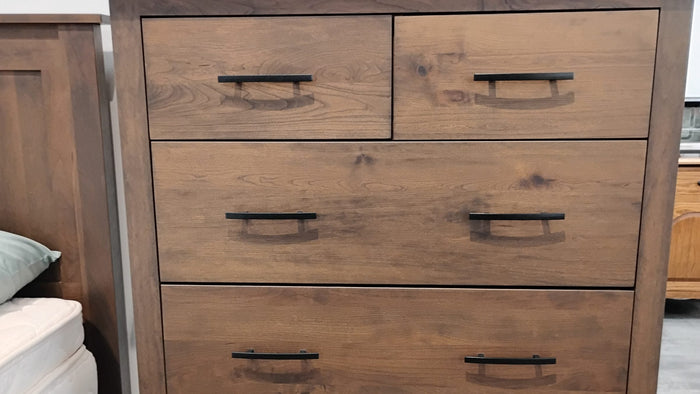


A dovetail joint locks two boards together at a corner with interlocking, fan-shaped "tails" and "pins." The flared shape resists being pulled apart, which is why furniture makers use it where a drawer front meets the drawer sides. A dovetail drawer is simply a drawer box built with these joints, usually at the front corners and often at the back too.
Key takeaways
- A dovetail joint is a set of wedge-shaped tails on one board that fit tightly into matching sockets on another. The shape does much of the holding, and glue does the rest.
- The main types are through, half-blind, sliding and secret (fully hidden) dovetails. On drawer fronts, half-blind dovetails keep the joint out of sight when the drawer is closed.
- More than 1,400 of the pieces on our site list dovetailed drawers, from dressers and nightstands to desks, file cabinets and end tables.
- To check a drawer, pull it all the way out and look at the corners, the bottom and the slides. Tight corners with no gaps are what you want to see.
What are dovetail joints?
Merriam-Webster describes a dovetail as "a joint between two pieces (as of wood) formed by a wedge-shaped part that fits tightly into a wedge-shaped slot in the other piece." The name comes from the shape. Each wedge flares out like the tail of a dove.
A dovetail has two parts:
- Tails: the flared, fan-shaped pieces cut into the end of one board.
- Pins: the narrower pieces cut into the end of the other board. They fill the gaps between the tails.
Both have a trapezoid shape, so they only fit together one way. Woodworkers cut the angle a little differently depending on the wood. Wikipedia notes a typical slope of 1:6 for softwoods and a shallower 1:8 for hardwoods, with 1:7 as a common middle ground.
The joint is old. Some of the earliest known examples are in ancient Egyptian furniture from the First Dynasty and in the tombs of Chinese emperors. It has stayed in use because it solves a real problem: holding a corner together when something keeps pulling on it.
How do dovetail joints work?
Think about what happens when you open a drawer. You pull on the front, and the front pulls away from the sides. On a drawer held together with only glue, nails or staples, that pull works against the fasteners every single day.
With a dovetail, the flared tails can't slide out in the direction you pull. The wider end of each tail is trapped behind the narrower opening of its socket. The harder you pull, the more the wood presses against wood. Wikipedia sums it up as a joint "noted for its resistance to being pulled apart," and adds that once glued, a wooden dovetail joint needs no mechanical fasteners.
The interlocking fingers also give glue more surface to grip than a flat corner does. Swedish Wood's Joinery Handbook says the relatively large glued surface makes this corner joint very strong, and calls the dovetail "the strongest corner joint in a master joiner's armoury."
What are the types of dovetail joints?
All dovetails use the same locking shape. What changes is where the joint shows and how the boards meet.
| Type | What you see | Where it's used |
|---|---|---|
| Through dovetail | The end grain of both boards shows at the corner, so the pattern is visible on both faces. | Boxes, chests and case corners, and often the back corners of a drawer |
| Half-blind dovetail | The joint shows on the side only. The front face stays solid. | Drawer fronts, so the joint is hidden when the drawer is closed |
| Sliding dovetail | A long tail-shaped rail slides into a matching groove across a board. | Shelves into cabinet sides, cabinet bottoms into sides |
| Secret (mitred) dovetail | Nothing. The corner looks like a plain angled seam. | Box and cabinet work where the joint should not show at all |
You may also hear two drawer terms. Wikipedia notes that in drawer construction, a dovetailed drawer is sometimes called an "English dovetail," while a stopped sliding dovetail, one that doesn't run the full width of the board, is sometimes called a "French dovetail." The terms are used loosely, so if a listing uses one, ask what it means for that piece.
What are dovetail drawers?
A dovetail drawer is a drawer box whose corners are joined with dovetails instead of staples, nails or plain glued edges. In traditional work, the front corners are usually half-blind, so you only see the joint when you open the drawer and look at the side. The back corners may be through dovetails. Woodcraft's guide to dovetailed drawers, for example, describes half-blinds at the front and through dovetails at the rear.
Dovetails are common in our catalog. On our Handcrafted to Last page we note that many of our builders use dovetailed drawers. When we went through the live product pages on our site this month, 1,461 of them mentioned dovetailed drawers or dovetail joints, from 16 different builders. They are not only bedroom pieces:
- More than 500 bedroom pieces: dressers, chests, nightstands, armoires and beds with drawers
- About 400 living room pieces: end tables, coffee tables, sofa tables and TV stands
- More than 300 office pieces: desks, file cabinets and bookcases with drawers
- More than 100 dining pieces, such as buffets, sideboards and hutches
One thing the pages don't do is name the style of dovetail. None of the pages we checked say "English" or "French" dovetail. They say "dovetailed drawers." If the exact style matters to you, open a drawer in the showroom or ask us to check with the builder.

How do dovetail drawers compare with other drawer joints?
Dovetails are not the only way to build a drawer. Each method trades time against strength in a different way.
| Drawer corner | How it holds | What to know |
|---|---|---|
| Dovetail | Interlocking shape plus glue | Resists the pull of opening a drawer. Takes more time to make. |
| Box (finger) joint | Straight, square fingers with a large glued area | Strong and quick to make, common in serial production. No flared lock. |
| Dowel joint | Wood pins glued into drilled holes | A common production method that relies on the glue and the dowels. |
| Staples or nails | Metal fasteners, often with glue | The University of Nebraska extension notes that staples or nails, found in lesser-quality pieces, may loosen and come out. |
Swedish Wood's handbook puts it plainly: dovetails "create a very strong joint but are time-consuming to make," so they "feature mainly in artisan production," while dowel joints, box joints and metal fittings suit large-scale production. That is the honest trade. A dovetailed drawer takes more work, and it is built for a drawer that gets pulled open thousands of times.
Are dovetail drawers worth it?
For a piece you plan to keep, they are one of the clearest signs that a drawer was built for daily use. A dresser drawer full of jeans, or a file drawer full of paper, carries real weight. Every time you open it, the front corners take the strain.
Still, a dovetail corner is only one part of a good drawer. The University of Nebraska extension guide to choosing case goods advises shoppers to take drawers out and examine them: they should be smooth and firm, not rough and wobbly, and they should move easily when you push or pull from either side. A dovetailed box with a thin bottom or a poor slide can still disappoint. Look at the whole drawer, and at the wood it is made from. Our solid wood furniture guide covers how to tell real wood from veneer and board.
How do you check a dovetail drawer before you buy?
You can do this in about a minute, in our showrooms or anywhere you shop:
- Pull the drawer all the way out. Look at the corner where the front meets the side. You should see fan-shaped tails and pins, not staples, nail heads or a flat seam.
- Check the fit. The tails and pins should sit tight and flush, without open gaps or filler.
- Look at the back corners. Some drawers are dovetailed at the front only. Neither is wrong, but it is good to know what you are buying.
- Look underneath. The bottom carries everything in the drawer. Some of our builders list the bottom thickness on the product page.
- Work the drawer. Open and close it fully. It should run smoothly, sit square and stop before it falls out.
Our heirloom furniture guide covers the other details that help a piece last, from drawer bottoms to finishes.

Do dovetail drawers come with soft-close or full-extension slides?
Often, yes, but it depends on the piece. The joint holds the box together. The slide decides how the drawer moves. A full-extension slide lets the drawer come all the way out, so you can reach the back. A soft-close slide slows the drawer near the end and eases it shut.
Among the 1,461 pages on our site that mention dovetails, 1,068, or about three in four, also list full-extension slides. About one in four list soft-close slides. Some, like the Williamsport 66'' Low Dresser, list both: dovetailed drawers with ½-inch thick drawer bottoms and full access under-mount soft close drawer slides. Others, like the Arlington Chest of Drawers, list dovetailed drawers with full extension drawer slides. Each product page lists its own features, so read it before you choose.
Pieces with dovetailed drawers
 Williamsport 66'' Low Dresser
 Williamsport Chest of Drawers
 Arlington Chest Of Drawers
 Williamsport 1 Drw Nightstand
Browse more pieces with dovetailed drawers in our dressers, chests of drawers and nightstands, or call us at 717-259-3842 to ask about a specific piece.
Frequently asked questions
Do dovetail joints need glue?
The shape holds the joint against pulling, but furniture makers usually glue dovetails too. Wikipedia notes that once glued, a wooden dovetail joint needs no mechanical fasteners such as nails or screws.
Are dovetail joints strong?
Yes. The flared tails resist being pulled apart, and the interlocking fingers give glue a large surface to grip. Swedish Wood's Joinery Handbook calls the dovetail very strong and notes that it takes more time to make than production joints like dowels or box joints.
What is the difference between English and French dovetail drawers?
In drawer construction, "English dovetail" usually refers to a dovetailed drawer box, while "French dovetail" usually refers to a stopped sliding dovetail that joins the front to the sides with one long tail in a groove. The terms are used loosely, so ask what a listing means.
Are half-blind dovetails as good as through dovetails?
They use the same locking shape. The difference is where the joint shows. Half-blind dovetails hide the joint from the front of the drawer, which is why they are common on drawer fronts.
Does all Amish furniture have dovetail drawers?
No. Many of our builders use dovetailed drawers, and the product page lists it when a piece has them. If a page doesn't mention it, ask us and we will check with the builder.
Sources
- Merriam-Webster: "dovetail" definition
- Wikipedia: Dovetail joint (types, slope, history)
- Swedish Wood: Joinery Handbook, section 4.1 Joints
- Woodcraft: Dovetailed Drawers
- University of Nebraska-Lincoln Extension: Selecting Case Goods, Woods (G95-1247)
- Product pages on kingsamishfurniture.com (as listed in November 2026)
- Our showroom team's experience with customers (2026)
How we made this guide: we counted how many live product pages on our site mention dovetailed drawers and which slides they list (as listed in November 2026), and compared the joint types with the woodworking references above.
See it in person
Visit our showrooms in Intercourse and Lancaster, PA, and Murrells Inlet, SC. Open Monday to Friday 10 to 5, Saturday 9 to 5.