How to Judge Furniture Quality: Joinery, Drawers and Finish
 By Michael King, Owner

To judge furniture quality, look past the showroom shine and test the parts that do the work. Pull a drawer all the way out and check its corners, bottom and slides. Push on the top to see if the case racks or wobbles. Look at the back, the underside and the inside of the doors. Then check the finish for an even, smooth surface.
Key takeaways
- Quality shows up in the parts you have to open, lift or turn over: drawer corners, drawer bottoms, slides, hinges, the back panel and the underside.
- Wide solid wood tops are almost always several boards glued together. A glued-up top is normal and sound, not a shortcut.
- A thin plywood back is not a red flag on its own. What matters is that the frame, top, sides and drawer fronts are solid wood and the joints are tight.
- Of the 3,546 pieces on our site, 1,461 list dovetailed drawers and about 1,070 list full-extension slides (as listed in November 2026).
- A finish should look even and feel smooth. It protects the surface and slows moisture change, but it cannot stop wood from moving.
What makes furniture good quality?
Good quality furniture does three things over many years. It stays square and steady, its moving parts keep working, and its surface can be cleaned and, if needed, repaired. Looks matter too, but almost any piece looks good on the showroom floor. The difference shows up after ten years of daily use.
Three things decide most of it:
- Materials. What the frame, top, sides and drawers are made of.
- Construction. How the parts are joined, and how drawers and doors are built and hung.
- Finish. How well the surface is sealed and how evenly it was applied.
The University of Nebraska-Lincoln Extension guide to buying case goods (chests, desks, beds, tables and chairs) makes a point worth knowing before you shop: solid woods are used for legs, frames, rails and corner posts, and "even solid wood chest tops, table tops and chair seats are several pieces of solid wood that have been joined and glued together." If you want to go deeper on materials, our guide to solid wood vs veneer vs MDF covers how to tell them apart. This guide focuses on how a piece is built.
What should you check in the store? A quick checklist
You can do every check below in a few minutes, with no tools. Ask the salesperson first if you can open drawers and look underneath. A good store will say yes.
| Check | What you want to see | Red flag |
|---|---|---|
| Steadiness | The piece sits flat. Pushing on a top corner barely moves it. | Rocking, racking or creaking when you push |
| Drawer corners | Tight interlocking joints (dovetails) with no gaps | Staples, loose glue blocks or corners that are only nailed |
| Drawer bottoms | A solid bottom that sits in a groove and does not sag when you press it | Thin board stapled to the bottom edge |
| Slides | Smooth, quiet travel; the drawer stops before it falls out | Sticking, side-to-side wobble, no stop |
| Doors and hinges | Even gaps around the door; it closes without rubbing | Sagging doors or gaps that are wider on one side |
| Back and underside | A back set into the frame and fastened all around | Thin panel tacked on with a few staples |
| Finish | Even color and sheen, smooth to the touch, edges covered | Drips, bubbles, rough or bare spots, blotchy color |

How do you judge furniture joinery?
Joinery is how the parts of a piece are fastened to each other. You rarely see the full joint, but you can see its results and often a bit of the joint itself.
Look at the corners
On a table or chair, look where the legs meet the apron or seat rails. The seam should be tight and even, with no gap you can slide a fingernail into. Turn a chair over if the store lets you. Glued and screwed blocks inside the corners add support. Staples alone in a load-bearing corner are a warning sign.
Look at the drawers
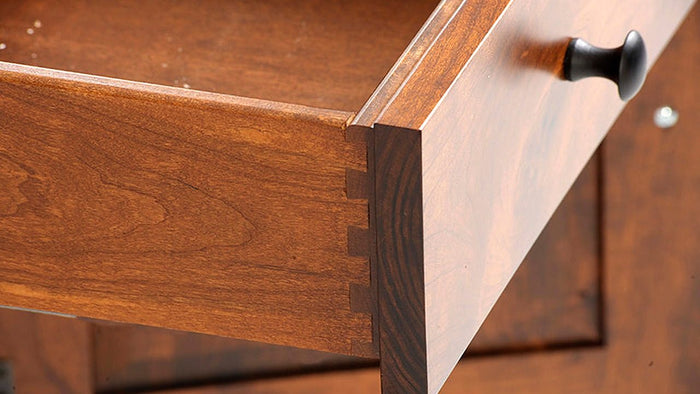
Drawer corners take a pull every time you open them, so they show a lot about how a piece was built. A dovetail is, in Merriam-Webster's words, "a joint between two pieces (as of wood) formed by a wedge-shaped part that fits tightly into a wedge-shaped slot in the other piece." The shape resists being pulled apart. More than 1,400 of the pieces on our site list dovetailed drawers. Our guide to dovetail joints and dovetail drawers explains the types and how to inspect one.
Test it with your hands
Put a hand on a top corner of a dresser or bookcase and push gently sideways. A well-built case barely moves. If it sways like a parallelogram, the joints or the back are not holding it square. Do the same with a table: lean on one end and see if it shifts.
Is glue a bad sign?
No. Glue is part of good joinery, and wide tops are made by gluing boards edge to edge. The UNL Extension guide notes that wide pieces of solid wood are rare, which is why tops and seats are glued up from several boards. What you don't want is glue doing a job that a proper joint should do, like a corner held only by glue and staples.
How can you tell a well-made drawer?
Pull the drawer all the way out. If it comes out, lift it and look at it from every side.
- Corners. Interlocking joints at the front corners, ideally at the back as well.
- Bottom. Press the middle of the drawer bottom. It should feel firm. Some of our pages list the thickness: 204 Millcraft pieces on our site list ½-inch thick drawer bottoms.
- Sides. Solid sides with clean, sanded edges, not rough cuts.
- Slides. Open and close the drawer a few times when it is empty. It should run straight and quiet.
- Stops. The UNL Extension guide advises that drawers should have stops so they won't pull out of the frame, and it mentions dust panels between drawers as a sign of careful work.
What kind of drawer slides should good furniture have?
There are good wooden slides and good metal slides. Metal full-extension slides let the drawer open all the way, so you can reach the back. Soft-close slides pull the drawer shut gently at the end. Undermount slides sit under the drawer, so you don't see them from the side. On our site, about 1,070 pieces list full-extension slides, more than 400 mention soft-close, and 207 list undermount slides (as listed in November 2026). The right one is the one that fits how you use the piece. A dresser that gets opened twenty times a day will feel very different with full-extension slides.

Is a plywood back a sign of poor quality?
Not by itself. This surprises many shoppers. Some of our product pages list a ¼-inch plywood back, while others, like several of our hutches, list a plain wood back. The UNL Extension guide explains why plywood is common in good furniture: it is made by gluing thin layers with their grain at right angles, so it "resists checking, splitting and warping."
The back of a case is a place where that matters. It sits against a wall, where it can get warm and dry out, and solid boards there can crack as the wood moves. The things to check are the parts you see and use: the top, sides, frame and drawer fronts should be solid wood, and the back should be set into the frame and fastened all the way around, not tacked on with a few staples. If you want a solid wood back, ask. Our team has arranged a finished solid wood back as an option on a special-order piece.
How do you judge a furniture finish?
A finish has three jobs. The USDA Forest Products Laboratory's Wood Handbook says finishes give wood its appearance, protect the surface and give you a surface you can clean. For indoor furniture, it notes, "appearance and a cleanable surface are generally most important."
To judge one in a store:
- Look at it in raking light. Stand at an angle to a window or lamp. The sheen should be even across the top, with no drips, bubbles, dust bumps or dull patches.
- Run your hand over it. It should feel smooth, including the edges and the corners of the top.
- Check the color. Stain should look even across boards. Natural grain and color differences between boards are normal in real wood; blotches and streaks from the stain are not.
- Look at the hidden surfaces. Check the inside of the doors, the drawer fronts' edges and the underside of the top. Those surfaces show how carefully the whole piece was finished.
A finish slows moisture change, but it does not stop it. The Wood Handbook says moisture changes "can be retarded, but not prevented, by protective coatings such as varnish, lacquer, or paint," and that the shrinking and swelling that follow "can result in warping, checking, and splitting." That is why construction matters as much as the coat on top, and why a stable room helps a piece last. Our wood furniture care guide covers humidity, sun and cleaning, and our stain color guide shows how the same stain looks on different woods.
What other signs of quality should you look for?
Hardware that fits the job
Pulls and knobs should be firm, with no wiggle. Doors should hang on hinges strong enough for their weight. The UNL Extension guide says doors should open and close easily, fit well and not sag.
Details you only notice up close
Look for clean, even edges on the top, panels that sit straight in their frames and moldings that meet neatly at the corners. Some makers sign their work. 221 Millcraft pieces on our site note that the piece is signed and dated by the craftsman.
Clear answers about how it is built
A store should be able to tell you what the frame, top, sides, drawers and back are made of, and how the drawers are built. If those answers are vague, take that into account. On our site, many product pages list features such as the drawer joinery and the drawer slides, so you can compare pieces before you visit.
Does a quality dresser still need to be anchored?
Yes. A heavy, well-built dresser can still tip if drawers are pulled open and a child climbs on them. The U.S. Consumer Product Safety Commission's Anchor It! campaign says anchoring all furniture with drawers, doors and shelves to the wall prevents tip-over injuries and deaths. A federal rule to prevent furniture tip-overs took effect on September 1, 2023. Quality construction and anchoring work together; one does not replace the other.

Pieces that list dovetailed drawers and full-extension slides
 Williamsport Chest of Drawers
 Elizabeth Lockwood 64'' High Dresser
 Mountain Lodge 1 Drw Nightstand
 Bowerston Buffet
Want to see these checks on real pieces? Browse our dressers, chests of drawers, nightstands and dining tables, read our guide on how to spot real solid wood, or call us at 717-259-3842 and stop by a showroom. Open every drawer you like.
Frequently asked questions
How can you tell if furniture is good quality?
Open the drawers and look at the corners, bottoms and slides. Push on the top to check that it stays square. Look at the back, the underside and the inside of the doors. Then check the finish for an even, smooth surface with no drips or bare spots.
Is plywood furniture bad quality?
Not necessarily. Plywood is made of thin layers glued with their grains crossing, which helps it resist splitting and warping. A plywood back on a solid wood case is common. Ask what the visible parts, the top and the drawers are made of.
Is glued furniture lower quality?
No. Wide solid wood tops are made by gluing several boards together, and glue is part of most sound joints. A glued-up top resists bowing and splitting. The concern is a corner that relies only on glue and staples.
Are dovetail drawers a sign of quality?
They are one good sign. Dovetails resist being pulled apart, which suits drawer fronts. Check that the joints are tight, the bottom is firm and the slides run smoothly. Our dovetail guide explains what to look for.
What finish is easiest to live with?
For indoor furniture, the Wood Handbook says appearance and a cleanable surface usually matter most. Look for an even, smooth finish that covers the edges, and keep the piece out of direct sun and away from heat vents.
Sources
- University of Nebraska-Lincoln Extension: Selecting Case Goods, Woods (G95-1247)
- USDA Forest Products Laboratory, Wood Handbook, Chapter 4: Moisture Relations and Physical Properties of Wood
- USDA Forest Products Laboratory, Wood Handbook, Chapter 16: Finishing of Wood
- Merriam-Webster: "dovetail" definition
- U.S. Consumer Product Safety Commission: Anchor It!
- Product pages on kingsamishfurniture.com (as listed in November 2026)
- Our showroom team's experience with customers (2026)
How we made this guide: we counted how many live product pages on our site list dovetailed drawers, drawer slide types, drawer bottom thickness and back panels (as listed in November 2026), and paired those counts with the extension, USDA and CPSC guidance linked above and the questions customers bring to our showrooms.
See it in person
Visit our showrooms in Intercourse and Lancaster, PA, and Murrells Inlet, SC. Open Monday to Friday 10 to 5, Saturday 9 to 5.