What Makes Amish Furniture Special, and Is It Worth It?
 By Michael King, Owner

Amish furniture is special because of who builds it and how. Most Amish-owned shops are small family businesses, and many of them make wood furniture. Builders work within their church's rules on technology. For you, the difference shows up in things you can check: the wood, how the drawers are built, and whether you can choose the wood, stain, hardware and size.
Key takeaways
- The Amish are a Christian group in North America. Most Amish shops are small family businesses with fewer than ten employees, and the bulk of them make wood products such as furniture, according to the Young Center at Elizabethtown College.
- "Amish furniture" is not one standard. Shops, church rules and materials differ, so judge each piece by what it is made of and who built it.
- Read the product page. Of the 3,546 product pages on our site, 3,303 let you choose the wood, and 1,461 mention dovetailed drawers.
- It is worth it if you plan to keep a piece for years and want it made for your room. If you need furniture this week, or only for a year or two, it may not be.
What is Amish furniture?
Amish furniture is furniture built by Amish craftsmen, often in small shops in Amish communities. To see why it is different, it helps to know a little about the people who make it.
Britannica describes the Amish as a Christian group in North America, mainly the Old Order Amish Mennonite Church, which began in the late 17th century among followers of Jakob Ammann. The Young Center for Anabaptist and Pietist Studies at Elizabethtown College traces their roots to the Anabaptist movement in Switzerland in 1525. The Amish formed their own group in 1693.
Today the Amish are a growing community. The Young Center's 2026 count lists about 414,545 Amish in the United States, living in 704 settlements. Pennsylvania, Ohio and Indiana have the largest populations. The two largest single settlements are the Lancaster County area in Pennsylvania (about 45,575 people) and the Holmes County area in Ohio (about 38,775).
From farms to woodshops
Until the 1960s, most Amish families lived on farms. The Young Center calls the shift to nonfarm work "the biggest change in Amish society in the last century." In some communities, fewer than 10 percent of households now earn their main income from farming.
Many of those families started shops. In the Young Center's words, "Most of these are small family businesses with fewer than ten employees. The bulk of these businesses produce wood products," including household and outdoor furniture. Furniture is one of the main things these shops make.
What makes Amish furniture special?
It is a mix of how the shops work and what that means for the furniture you bring home.
Small shops, not big factories
A shop with a handful of people builds fewer pieces, and the people building them are often family. For a buyer, a small shop also means a builder who can make changes to a design instead of running the same piece down a line.
Technology chosen on purpose
A common myth is that the Amish reject all technology. The Young Center says it is "more accurate to say that they use technology selectively." Most Amish groups forbid electricity from public utility lines, yet the Amish "readily buy much modern technology, such as gas grills, shop tools, camping equipment, and some farm equipment." Rules are set by each local church, so one shop can work quite differently from the next.
Solid wood you choose
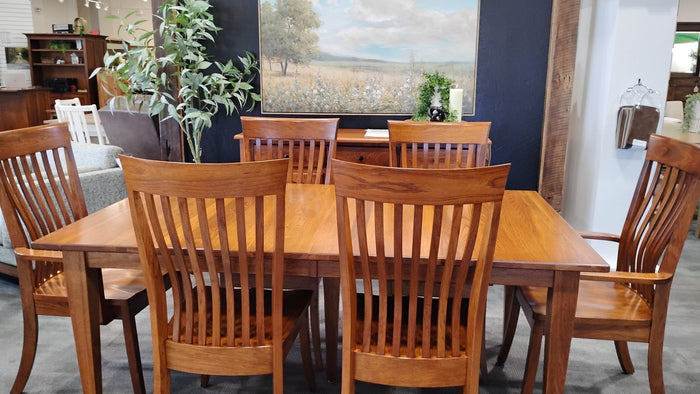
On our own site, the wood is a choice you make, not something decided for you. Of our 3,546 product pages, 3,303 offer a wood option. Of the 1,730 pages with a "Wood Species" list, 1,684 offer 11 or more choices, with rustic and quartersawn versions counted as their own options. Brown maple, cherry, hickory and oak appear on most of them. Our wood guide compares how the species differ in hardness, grain and color.
Drawers and details you can check
Good furniture tells you how it is built. On our product pages, 1,461 mention dovetailed drawers, 448 list soft-close drawer slides, and 221 say the piece is signed and dated by the craftsman. These are details you can read before you buy and check with your own hands in a showroom.
Made for your room
Most of our furniture is made to order. Our FAQ lists the options: wood type, stain color, hardware and dimensions. If you can't find a piece in the catalog, our custom furniture team can ask a builder to make it.

How to judge a piece of Amish furniture
Because "Amish" describes who built a piece, not a fixed recipe, the label alone doesn't tell you much. Use this checklist in a store or on a product page.
| What to check | What to ask | What our product pages show |
|---|---|---|
| Who built it | Which shop made this, and where is it? | We work with more than 40 Amish builders. Our team can tell you who builds a piece. |
| The wood | What wood is it, and can I pick another? | 3,303 of 3,546 pages offer a wood choice |
| The drawers | How are the drawer corners joined? What slides do they run on? | 1,461 pages mention dovetails; 448 list soft-close slides |
| Finish and hardware | Can I choose the stain and the pulls? | Stain and hardware are customization options in our FAQ |
| Size | Can it be made wider, taller or deeper? | Dimensions are listed as a customization option |
| Signature | Does the builder sign the piece? | 221 pages say the piece is signed and dated by the craftsman |
If a store can't say what the top, sides and back are made of, ask before you order. Our guide to solid wood vs veneer vs MDF shows how to tell them apart.
Is Amish furniture worth it?
For many families, yes. But it depends on how you live and how long you plan to keep the piece.
When it makes sense
Family homes are hard on furniture. A dining table has to handle holiday meals that get bigger every year, homework spread across the top and a puzzle left out for days. A desk gets used every school day. A dresser's drawers get opened every day. If a piece will work that hard, it pays to know what it is made of and how the drawers are built.
It also makes sense when the room is the problem: an alcove that needs a certain width or a table that has to seat everyone. Made-to-order furniture solves that instead of settling for the closest size.
When it may not be
- You need it now. Made-to-order pieces are built after you order, so you wait for them.
- You plan to replace it soon. If you are furnishing a short-term rental or a first apartment you will leave in a year, the extra cost may not pay off.
- The piece doesn't list its materials. An "Amish" label is not a reason to skip the questions in the table above.
As our founder Raymond King puts it, "Not all Amish furniture is created equal." The point is to find the right piece for your needs, not just a name.

Why is Amish furniture so expensive?
Amish furniture often costs more than furniture made in volume. A few reasons explain most of the gap:
- Solid wood instead of panels. Furniture made in volume is often built from composite panels covered with veneer or a printed surface, which are cheaper to work with than boards.
- Small shops. A shop with fewer than ten people builds fewer pieces than a factory line.
- Built for you. When a piece is made to order in the wood, stain, hardware and size you pick, it is built one at a time.
The fair way to compare is not price on day one but how long you will use the piece and whether it can be repaired or refinished later. Our guide to heirloom furniture covers what helps a piece last.
Is Amish furniture really made by the Amish?
It should be, but the only way to know is to ask. A store that works with builders directly can tell you which shop made a piece and where that shop is.
The Young Center describes "many different affiliations of Amish, each of which has its own dress styles, carriages, occupations, and rules about technology." Two Amish shops can use different tools and methods, so judge the piece, not the label.
Our family has been selling furniture since 1986. Kings Amish Furniture began in Raymond King's little woodshop, where he built outdoor tables and chairs and sold them on his front lawn. That time in the shop is why we still look closely at wood, craftsmanship and details when we choose furniture from our Amish craftsmen. You can read more in our story.

How to buy Amish furniture
- Start with the room. Measure the space and decide how the piece will be used every day.
- Pick the wood. Harder woods resist dents better. Grain and color matter too. Our wood guide compares the species.
- Choose the finish and hardware. Free stain samples help you see the color on real wood. Our stain color guide shows the families of colors.
- Ask about size changes. Dimensions are one of our customization options, so ask whether the piece can be built wider, taller or deeper.
- Confirm the details in writing. Wood, stain, hardware and size should all be on your order. Our guide to ordering custom Amish furniture walks through each step.
Here are a few pieces whose pages list these details. The Ashton 66" Dresser lists dovetailed drawers, soft-close drawers and a craftsman's signature and date. The Fenton Double Pedestal Table offers 15 wood choices and leaves that can store inside the table. The Denali Writing Desk has a dovetailed drawer and a finished back, so it can face the room.
Pieces whose pages list these details
 Ashton 66" Dresser
 Fenton Double Pedestal Table
 Denali Writing Desk
 Ashton 3 Drawer Nightstand
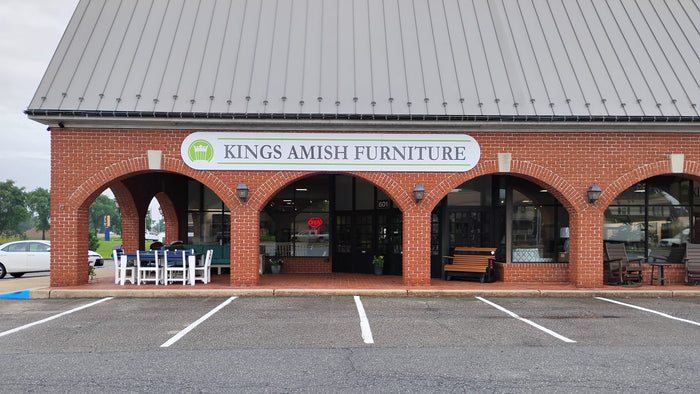
To see more, browse all our furniture or visit one of our showrooms in Intercourse, PA, Lancaster, PA or Murrells Inlet, SC. Hours and directions are on our locations page.
Frequently asked questions
Is Amish furniture good quality?
It can be, but quality depends on the builder and the materials, not the label. Check what the wood is, how the drawers are joined and what slides they run on, and ask who built the piece.
Where is most Amish furniture made?
Amish shops are spread across many states. The largest Amish populations are in Pennsylvania, Ohio and Indiana, and the two largest settlements are the Lancaster County area in Pennsylvania and the Holmes County area in Ohio. Most of the builders we work with are in Ohio.
Is Lancaster, PA Amish country?
Yes. The Young Center lists the Lancaster County area as the largest Amish settlement in its 2026 count, with about 45,575 people. Our two Pennsylvania showrooms are in Intercourse and Lancaster, both in Lancaster County.
Can you customize Amish furniture?
Often, yes. At our store, customization options include wood type, stain color, hardware and dimensions. If you can't find what you need in the catalog, our custom furniture team can ask a builder to make it.
Do the Amish use power tools?
Many do, within their church's rules. The Young Center says the Amish use technology selectively. Most groups forbid electricity from public utility lines, but the Amish readily buy shop tools, and the rules vary from one church to the next.
Sources
- Young Center for Anabaptist and Pietist Studies, Elizabethtown College: Occupations
- Young Center for Anabaptist and Pietist Studies: Technology
- Young Center for Anabaptist and Pietist Studies: Frequently Asked Questions
- Young Center for Anabaptist and Pietist Studies: Amish Population, 2026
- Young Center for Anabaptist and Pietist Studies: Twelve Largest Amish Settlements, 2026
- Britannica: Amish
- Product pages, FAQ, Our Story and Custom Furniture pages on kingsamishfurniture.com (as listed in November 2026)
How we made this guide: we read what the Young Center at Elizabethtown College and Britannica say about Amish history, work and technology, then counted how wood choices, drawer construction and builder signatures appear on all 3,546 active product pages on our site. The showroom note comes from questions our team answers on the phone. Every fact was checked against our product pages.
See it in person
Visit our showrooms in Intercourse and Lancaster, PA, and Murrells Inlet, SC. Open Monday to Friday 10 to 5, Saturday 9 to 5.