Shaker Style Furniture Explained: History, Look and How to Spot It
 By Michael King, Owner

Shaker style furniture is a plain, practical American furniture style that comes from the Shakers, a religious community that settled in America in the late 1700s. It has slender legs, flat surfaces, simple knobs and almost no carving or inlay. The look depends on good proportions and on each piece doing its job well.
Key takeaways
- Shaker furniture was made by and for Shaker communities. They cut out ornament such as inlay, veneer and carving and let form and proportion carry the design.
- The signs to look for: thin turned or tapered legs, plain tops with a soft edge, flat panel doors, simple knobs and light, open bases.
- Shaker and Mission are often mixed up. Shaker looks lighter and older; Mission is squarer and heavier and came about a century later.
- "Shaker" on a furniture page today names a look, not a maker. We have 99 pieces with Shaker in the name, from tables and beds to TV stands and desks.
What is Shaker style furniture?
Britannica describes Shaker furniture as "furniture designed for and by the religious colonies of Shakers founded in America in the last quarter of the 18th century." Its designs, Britannica says, are "characterized by an austerity of decoration and truth to materials." In plain words: nothing is added just for show, and the wood is allowed to look like wood.
The Shakers believed that making a thing well was a form of prayer, and that how a thing looks should follow from what it does. Each item was made for its use, and extras like inlays and moldings were left off. The U.S. National Park Service sums up the style in three words: simplicity, utility and craftsmanship.
That is why Shaker furniture still feels current. With no fussy details to date it, a Shaker table or dresser fits in a farmhouse, a traditional home or a clean, modern room.

Who were the Shakers, and why is it called Shaker furniture?
The Shakers' formal name was the United Society of Believers in Christ's Second Appearing. According to The Metropolitan Museum of Art, the first Shakers came to America from England in 1774, led by Ann Lee. People called them the "Shaking Quakers," and later just Shakers, because of the dancing and movement in their worship. The furniture takes its name from the people who made it.
The Shakers lived in communities that grew their own food and made their own buildings, tools and furniture. At their height in the mid-1800s, the Met says, there were more than 6,000 members in eighteen communities from Maine to Kentucky. The largest was at New Lebanon, New York, founded in 1787. Shakers did not marry or have children, so the communities slowly shrank. Today only one active community remains, at Sabbathday Lake in Maine, with just a handful of members.
The Shakers also sold furniture to outsiders. By the 1860s, chairmaking was a main business at New Lebanon, and the National Park Service notes that their ladder-back chair won a medal at the 1876 Philadelphia Centennial Exhibition. That trade is one reason the style spread so far beyond the communities themselves.
What does Shaker furniture look like?
You can spot Shaker style by what it leaves out as much as by what it has. Here are the main features, part by part.
Legs
Shaker legs are slender. They are usually turned (shaped round on a lathe) or tapered so they narrow toward the floor. This makes even a large table look light. The Met points out that Shaker makers moved the stretcher on their trestle tables up from near the floor to just under the top. That gave more legroom and made the base look more open.
Tops and edges
Tops are flat and plain, with a simple, softened edge rather than a carved or molded one. On today's Shaker dining tables this usually means an eased edge: a lightly rounded corner that is comfortable to lean on.
Doors and drawers
Cabinets have flat panel doors and plain drawer fronts. The Shakers liked built-in storage, and the National Park Service notes that built-in cupboards and drawers were used extensively in Shaker buildings. Freestanding pieces were often made to fit a specific spot in a room.
Hardware
Instead of imported brass pulls, the Met says, Shakers used simple turned wood knobs. Many Shaker style pieces made today use small metal knobs instead, which keeps the same simple look.
Wood and finish
The Shakers used local American woods. The Met lists pine, maple and cherry, and the Park Service adds birch, chestnut and butternut. Most original pieces were painted or stained, both to protect the wood and to make it look good, and many that now have a clear finish were refinished by later owners.
Shaker vs Mission furniture: what's the difference?
These two styles get mixed up more than any others, because both are simple, American and made of solid wood. Our guide to Mission style furniture covers Mission in depth. Here's the short version side by side.
| Shaker | Mission | |
|---|---|---|
| Where it comes from | Shaker religious communities, late 1700s and 1800s | American Arts and Crafts period, about the 1890s to 1910s |
| Overall look | Light, slender, delicate | Square, solid, a bit heavy |
| Legs | Thin, turned or tapered | Thick and square |
| Details | Almost none; proportion does the work | Slats, flat panels and visible construction |
| Traditional woods | Local woods such as maple, cherry and pine | Oak, often quartersawn white oak |
A quick test: if the piece looks light and the legs are thin, think Shaker. If it looks sturdy and square with slats on the sides, think Mission. The two sit well together, and both pair easily with newer furniture. Our article on Amish furniture for modern homes shows how clean-lined pieces work in today's rooms.
Is Shaker furniture the same as Amish furniture?
No. The Shakers and the Amish are two different religious groups. "Shaker" describes a design style. "Amish-made" describes who builds the furniture and how.
Today, Shaker style is one of the styles Amish builders make, and much of the Shaker style furniture we sell is Amish-made in solid wood. So you can own a Shaker style table that is also Amish-made, but the two words answer different questions: what it looks like, and who made it.
What Shaker style furniture can you buy today?
We looked at every live product on our site with "Shaker" in its name. As listed in November 2026, there are 99, from several builders, including Y&T Woodcraft, Ashery Oak, Wengerd Wood Products and Hermie's Table Shop. Here is how they break down.
| Type of piece | Shaker pieces on our site |
|---|---|
| Tables (10 dining and pub tables, 15 coffee, end, sofa and hall tables) | 25 |
| Desks, file cabinets and desk hutches | 24 |
| TV stands and media consoles | 24 |
| Bookcases | 7 |
| Chairs and bar stools | 7 |
| Beds | 5 |
| Hutches, buffets and sideboards | 4 |
| Sofa, loveseat and recliner | 3 |
A few honest notes from reading those pages:
- The name is used loosely. Today, "Shaker" on a furniture page means simple lines, not a copy of a museum piece. Several of our Shaker TV stands have glass doors or an arched top, which the original Shakers did not make.
- Hardware has changed. 21 of the 99 pages list knobs, but only one of them lists wood knobs. Many list flat black knobs instead.
- The wood is your choice. 98 of the 99 pages offer oak, cherry, hickory, brown maple and white oak, and 87 offer walnut. A Shaker piece in cherry or maple stays close to the originals. In rustic hickory it looks more casual.
- Check the drawers. 41 of the 99 list dovetailed drawers. If drawers matter to you, read the features on the page or ask us. Our guide to dovetail drawers explains what to look for.

How to tell if a piece is Shaker style
Use this checklist in a store or on a product page.
- Look at the legs. Thin and tapered or turned? That points to Shaker. Thick and square points to Mission.
- Look for ornament. Carving, inlay, applied moldings or curvy aprons mean it is a different style.
- Check the doors. Shaker doors are flat panels in a plain frame, with no raised or carved detail.
- Check the hardware. Small round knobs fit the style. Large decorative pulls usually don't.
- Read the wood and edge. A solid wood top with a soft, eased edge is typical. Ask what the piece is made of; our guide to furniture woods helps you compare.
How to use Shaker style furniture in your home
Dining room
A Shaker leg table with ladder-back or slat-back chairs is the classic start. Because the base is light and open, it works well in smaller dining rooms and eat-in kitchens. Browse our dining tables and look for "Shaker" in the name, or start with the Shaker Leg Table, which comes in square and rectangle sizes with optional 12-inch leaves.
Bedroom
Shaker beds keep the headboard and footboard plain. Two of ours offer a 15-inch low footboard, which keeps the room feeling open, and two can be ordered with drawer storage in the side rails. See our guide to bed frame types for help choosing a frame.
Home office and living room
Shaker desks, file cabinets and bookcases are some of the easiest pieces to fit into a working room, because plain fronts don't compete with what you put on the shelves. A Shaker bookcase like the 36-inch Shaker Bookcase with Doors comes in several heights, so you can match it to your wall.
Mixing styles
Shaker pieces mix well with almost anything because they have so little ornament. Pair a Shaker table with upholstered chairs for a softer look, or with a Mission sideboard if you like solid oak. Your stain choice has a big effect too; our guide to Amish stain colors shows the options side by side.
Shaker style pieces you can order
 Shaker Leg Table
 Shaker Chair
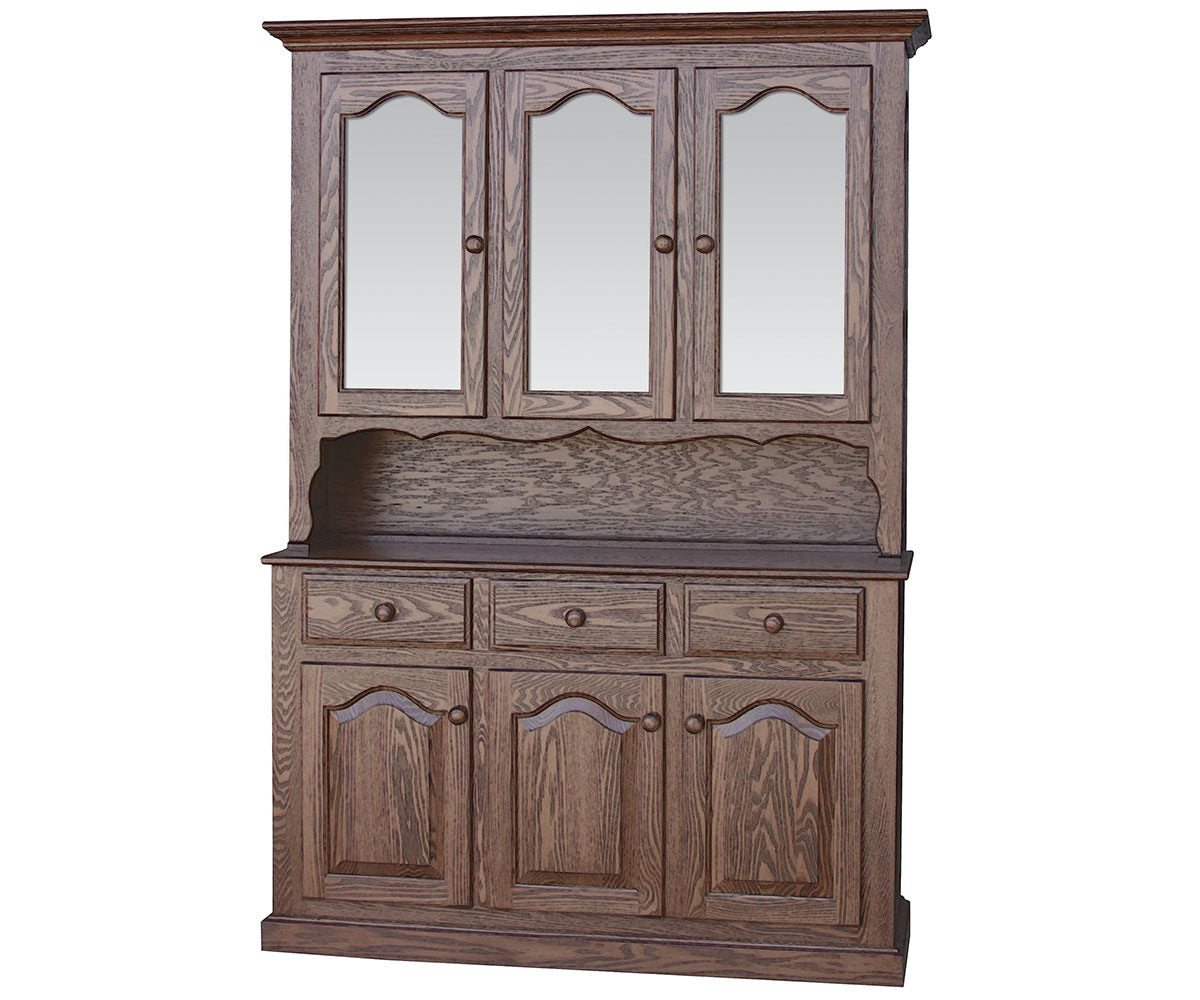
 Shaker Hutch
 Shaker Bookcase With Doors – 36"W
Frequently asked questions
What is Shaker style furniture?
It is a simple American furniture style that began with the Shakers, a religious community active from the late 1700s. It has slender legs, flat surfaces, plain knobs and almost no decoration, and it puts usefulness and good proportions first.
Why is it called Shaker furniture?
It is named after the people who made it. The Shakers were known as the "Shaking Quakers" because of the movement and dancing in their worship, and the name stuck to their furniture.
What is the difference between Shaker and Mission furniture?
Shaker is older and lighter, with thin turned or tapered legs and almost no detail. Mission came from the Arts and Crafts period around 1900 and is squarer and heavier, with thick legs, slats and visible construction, usually in oak.
What wood is used for Shaker furniture?
The original Shakers used local woods such as maple, cherry, pine, birch and butternut. Today's Shaker style pieces are made in many hardwoods. On our site, 98 of 99 Shaker pieces offer oak, cherry, hickory, brown maple and white oak.
Is Shaker style out of style?
Because it has no trendy details, Shaker style doesn't date quickly. It fits farmhouse, traditional and modern rooms, which is why makers keep building it in so many forms.
Is Shaker furniture Amish?
Not by origin. The Shakers and the Amish are different groups. But Amish builders make Shaker style furniture today, and much of the Shaker style furniture we sell is Amish-made.
Sources
- The Metropolitan Museum of Art: Shaker Furniture (Heilbrunn Timeline of Art History)
- The Metropolitan Museum of Art: Shaker Retiring Room
- Britannica: Shaker furniture
- Britannica: Shaker (religious group)
- U.S. National Park Service: Shaker Style
- Product pages on kingsamishfurniture.com (names, woods and features as listed in November 2026)
- Our showroom team's experience with customers (2026)
How we made this guide: we read the museum, encyclopedia and National Park Service sources above, then went through the 99 Shaker product pages on our site (as listed in November 2026) to count piece types, wood options and features, and added what our customers choose and ask about in our showrooms.
See it in person
Visit our showrooms in Intercourse and Lancaster, PA, and Murrells Inlet, SC. Open Monday to Friday 10 to 5, Saturday 9 to 5.